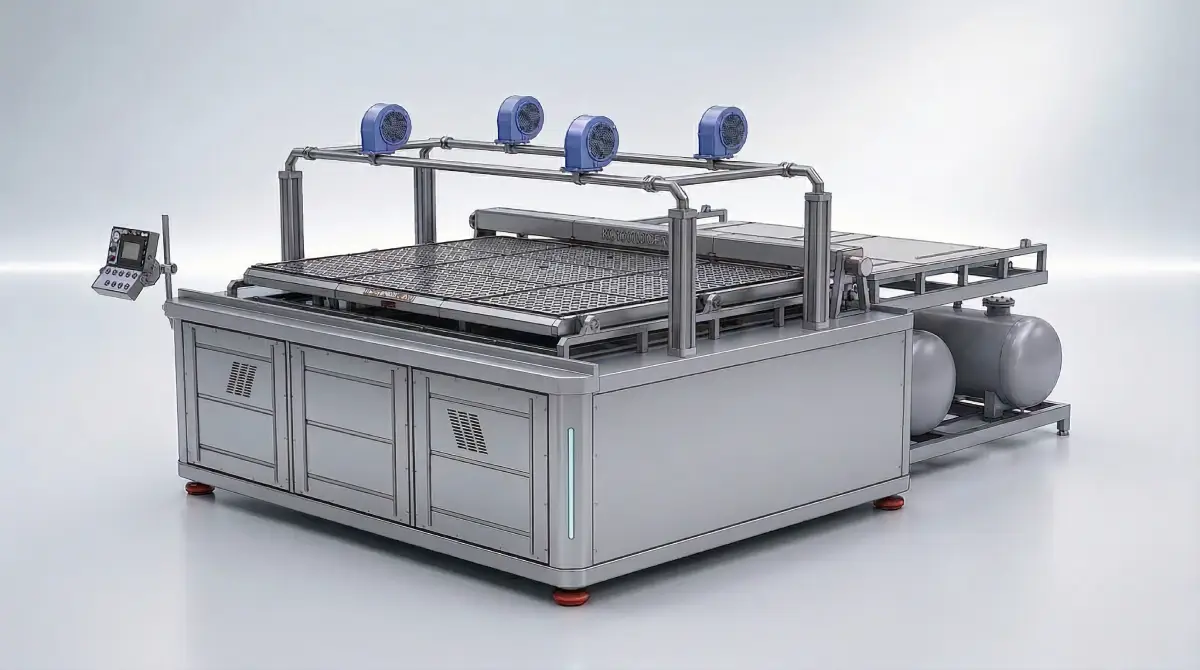
THERMOFORA · Updated 2026 · 18 min read
This guide is written for buyers who want to choose the right vacuum forming machine before spending money. It is based on practical work with machine selection, troubleshooting, retrofits, and thermoforming production requirements.
Every year people come to me after already buying a machine. One bought a forming area half the size he needed. Another spent a year retrofitting a cheap unit to do what he actually required. A third overpaid for automation he will never use. This guide exists so you can sort all of this out before the money moves.
No brand recommendations. No filler. Just the things that actually determine whether a vacuum forming machine will produce consistent parts for years or become a problem you manage daily.
Part 1
Four Questions to Answer Before You Buy Any Vacuum Forming Machine
Most buying mistakes come down to one thing: people start looking at machines before they understand their own requirements. These four questions define what kind of vacuum forming machine you should buy, what options you need, and what budget actually makes sense.
Question 1. What forming area do you actually need?
The most common buying error is assuming the machine's forming area only needs to match your part footprint. It does not. When a heated plastic sheet is drawn over a mold, the material travels not just downward but outward from all sides. That material has to come from somewhere — and it comes from the flat border around your part geometry.
Example: a part 1000 × 1000 mm with a height of 200 mm. Calculation: 200 × 0.75 × 2 = 300 mm of extra material needed. Minimum forming area: 1300 × 1300 mm.
For forming depth, add at least 20% above your part height. A 200 mm tall part means you should specify at least 240 mm of forming stroke. The sheet sags slightly during heating and needs extra space. If you buy a machine based only on part footprint, you will undersize it.
Question 2. What materials will you be forming?
This is not just a list of plastics. Your answer determines heater type, whether you need single-sided or dual-sided heating, drying requirements, mold temperature strategy, and a range of process options. Different thermoplastics behave very differently in the oven and on the mold — and the wrong machine configuration makes some of them impossible to run reliably.
If you are still deciding on materials or are just starting out, our article on choosing the right plastic for vacuum forming covers forming temperatures, shrinkage rates, drying requirements, and which applications each material suits.
Question 3. What sheet thickness range do you need?
Sheet thickness directly determines whether single-sided or dual-sided heating is required. The working rule is simple: sheets up to 6 mm can usually be formed with top-only heating. Above 6 mm, dual-sided heating is usually required. With top heat only, the upper surface reaches forming temperature while the core and bottom are still too cold, and the result is a part with internal stress, unstable wall distribution, and visible defects.
In practice, roughly 80% of all vacuum formed parts use sheet under 6 mm. Dual-sided heating is sometimes applied even to thinner sheet when exceptional uniformity is required, but that is the exception. If your work is comfortably under 6 mm and budget matters, single-sided heating is usually the right machine to buy.
Question 4. What is your production volume?
Five parts a month and continuous shift production are completely different buying problems. Production volume determines the machine category, the level of automation that makes sense, the acceptable cycle time, and the budget you can justify. There is no universal best machine. But confusing a prototyping requirement with a production requirement, or the reverse, is one of the most expensive buying mistakes in this market.
Part 2
Three Vacuum Forming Machine Categories — and Which One You Should Buy
The vacuum forming equipment market splits into three distinct categories. They differ not just in price, but in process control, output quality, maintenance burden, and how much of your time the machine will consume after purchase.
Category 1. Low-cost and hobbyist machines
These machines usually have two functional assemblies: a heating element and a vacuum system. No meaningful zone control, no real sheet support during heating, no pre-stretch bubble, and no proper industrial recipe storage. The clamping frame is manual. Controls are usually timers or simple switches.
This category can work if your parts have simple geometry, surface finish is not critical, you are producing a handful of parts per month, and you are willing to continuously adjust, weld, adapt, and upgrade the machine as needs evolve. In practice, a significant share of operating time with these machines goes into maintaining and modifying the machine rather than producing parts.
Typical price range: $500 to $5,000.
Category 2. Mid-range industrial machines
This is the category most buyers should focus on. It is also where the large majority of manufacturers end up. Machines in this class can produce virtually all standard industrial thermoformed parts and include the core options that actually matter: zoned heating, pneumatic clamping, a vacuum receiver, HMI with recipe storage, pre-stretch, and a cooling system.
The main difference versus Category 3 is lower automation and somewhat lower throughput under continuous full-shift loading. For most industrial users, that difference is irrelevant. If your work is standard production forming, you do not need fully automated sheet handling, and your economics do not depend on maximum parts-per-hour output, this is usually the best vacuum forming machine category to buy.
Typical price range: $5,000 to $150,000. The spread is wide because forming area, heater power, frame design, control sophistication, and option set can differ enormously inside this category.
Category 3. Top-tier automated production lines
Maximum option count, minimum operator influence, maximum throughput and automation. Automatic sheet loading, inline trimming, robotic stacking, servo motion systems, advanced diagnostics, and factory integration all belong here.
If you truly need this category, you usually already know it. Purchase decisions at this level are driven by cost-per-part modeling, production volume, labor reduction, and payback period before any machine is specified. Typical price starts around $150,000 and can go to $1.5 million or more. This equipment is justified only for high-volume serial production where automation directly reduces unit cost. In most other cases, it is the wrong investment.
Part 3
Technical Specifications That Actually Matter When You Buy a Vacuum Forming Machine
When you start comparing machines, sellers will throw numbers from brochures at you. Most of those numbers tell you very little unless you know what they actually mean in production. These are the specifications that matter when buying.
Heating system
For any non-hobbyist vacuum forming machine, there are two main heater types in industrial use: quartz infrared emitters and halogen infrared emitters. Within each type there are meaningful differences in element manufacturer, wire type, thermal response, service life, and emission wavelength.
Both can form plastic successfully, but with different process characteristics and cost profiles. In general, quartz emitters are used in most Category 2 industrial machines, with emission wavelength roughly in the 2 to 6 micron range. Halogen lamps are more common in higher-cost automated machines, with wavelength roughly in the 0.8 to 3 micron range depending on type.
Why this matters: plastic does not absorb infrared energy equally at all wavelengths. The optimal absorption band for many thermoplastics is roughly in the 1 to 4 micron range. Halogen heaters can heat plastic faster than quartz at equivalent power, but they cost more. Quartz emitters remain the proven, economical choice for most industrial vacuum forming applications.
On single-sided versus dual-sided heating: as noted above, 6 mm is the practical dividing line for many applications. If you do not yet know your final material mix and budget is constrained, single-sided heating is often the right starting point. If you know you will form heavy gauge material, buy dual-sided heating from the start.
Zone control is another major factor. The rule is simple: the smaller the independently controlled zone, the better the thermal management and the more uniform the sheet heating. But every additional zone increases machine cost, so manufacturers compromise by grouping several elements per zone. When evaluating a machine, look not just at zone count but at zone geometry. Good heater zoning reflects real heat distribution physics, not just equal square segmentation for convenience.
Vacuum system
There are a few principles here that matter before you buy anything.
First and most important: evacuation speed is often more important than ultimate vacuum level. The moment a heated plastic sheet contacts the mold, it starts cooling. The faster air is evacuated, the more accurately the sheet follows the tool surface before it stiffens. This is why a receiver tank is not optional on any serious machine. As a practical rule, receiver volume should be at minimum four times the volume of your largest mold.
Second: a well-designed vacuum system needs fine control. The operator should be able to disconnect the receiver and run on the pump alone — this matters for process development and specific part types. A vacuum regulator for controlling evacuation speed and forming force is also worth having.
Third: the receiver should be plumbed in parallel, not in series. It should cut in at the forming moment and automatically shut off at a defined residual pressure. That layout gives the fastest possible evacuation at the critical moment while protecting the pump and improving repeatability.
Clamping frame
The clamping frame holds the sheet during heating and forming. It looks simple. It is not.
First check whether the machine has a format reduction system. This mechanism allows you to clamp smaller sheets than the machine's maximum format. Without it, you are locked into one sheet size or you waste material unnecessarily.
Second: during operation, the clamping frame and machine bed heat up significantly. Metal expands. If the design does not account for thermal expansion, the frame gradually distorts and clamping consistency drops. That affects part quality, edge sealing, and long-term machine geometry. Good machines solve this structurally, not through constant operator adjustment.
Core options — what the machine must have
These are not luxury extras. Their absence directly limits what you can produce and how consistently you can produce it. If you are buying an industrial vacuum forming machine, this is the minimum option set worth paying for.
- Pre-stretch bubble (plug assist pre-blow). Before vacuum is applied, the sheet is inflated upward into a dome with air from below. This redistributes material more evenly across the mold and reduces wall thickness variation in deep-draw parts. Without this function, deep geometry almost always produces pronounced thinning at the walls.
- Sheet support during heating. Many plastic sheets sag under their own weight as they heat. That sag creates an uneven temperature profile across the sheet surface — the areas that drop closer to the heater get hotter than the rest. Sheet support, usually an air cushion from below, holds the sheet at a stable level throughout the heat cycle. This is not an advanced option. It is basic process control.
- Mold venting (blow-off). After forming, compressed air is sent back through the vacuum channels to push the part off the mold. This prevents deformation during release and eliminates sticking, especially on deep molds and with flexible materials.
- Cooling. Two main types are common: air cooling and air-water mist cooling. Air cooling is sufficient for many applications. When cycle time matters, mist cooling shortens the cooling phase and helps improve dimensional stability by evening out cooling across the part surface.
- HMI with recipe storage. Standard on any industrial machine worth the name. The control system needs enough parameter depth to tune each part correctly, and it needs to save that program so operators can recall it reliably. Physical control buttons for key systems are also worth specifying because they matter in real production.
Part 4
Building Thermoforming Machine From Professional Engineering Drawings
If buying a finished vacuum forming machine is too expensive, building one from professional engineering drawings is a serious lower-cost alternative. This option is becoming increasingly popular, and we see it clearly in our own clients. Instead of purchasing a finished machine, you manufacture one from a complete set of CAD drawings at your own facility or through outsourced fabrication services.
A full drawing package includes the frame structure, platen assemblies, clamping frame with format reduction system, vacuum system layout, electrical schematic, and machine control software. The machine is then built from locally available components and standard structural steel.
The advantages are straightforward: capital cost is substantially lower than buying equivalent ready-made equipment, and you come away understanding your machine completely — which simplifies maintenance, troubleshooting, and future modifications. The limitations are also real: this route requires fabrication resources, takes longer before first production, and puts engineering responsibility for the build on your side. But for technically capable teams, it can be the smartest path.
We offer professional CAD drawings for several machine models, from the compact SMARTFORM 450 to the large-format LITE 3020. If you want to know whether buying a finished machine or building from drawings is better for your situation, take a look at the available machine drawings and reach out with your requirements.
1. Buying a new machine
Best forCompanies that want the shortest path to production, supplier support, and the lowest startup uncertainty. Higher upfront cost, but lower build risk and faster launch.
2. Buying a used machine
Best forBuyers with strong technical knowledge who can inspect machine condition properly. Lower purchase price, but higher risk if heater zones, vacuum response, frame geometry, controls, or spare part availability are poor.
3. Building from drawings
Best forTechnically capable teams with fabrication access that want to reduce capital cost and fully understand the machine they run. Slower path to production, but often the strongest value if you can execute the build properly.
Part 5
Common Forming Defects: What They Tell You Before You Buy a Vacuum Forming Machine
When evaluating a machine — especially a used vacuum forming machine — ask the seller to run a real forming cycle and inspect the part carefully. Part defects often tell you faster than any brochure what is missing, misadjusted, or no longer working in the equipment.
1. Bubbles and blisters on the surface
What it meansOverheating or moisture in the sheet. The cause can be operator error — wrong temperature setting or cycle time — or a failure in the temperature control system. On a properly functioning machine with stable zone control, this is usually easy to correct. If it persists, the heating system may not be controlling consistently.
2. Webbing between features
What it meansInsufficient pre-stretch, sheet too cold at forming, or mold features positioned too close together. If this defect appears consistently across cycles, the machine may lack a proper pre-stretch function or the system is not working correctly.
3. Uneven wall thickness
What it meansUneven heating from a failed heater zone, insufficient evacuation speed, poor receiver sizing, or no plug assist. Any of these can produce the same result: material that was not uniformly ready or not uniformly distributed at the forming moment.
4. Warping after demolding
What it meansInsufficient or uneven cooling, or forming at too low a sheet temperature — the part leaves the mold with internal stress that releases as cooling continues. A proper cooling system and stable thermal process should prevent this.
5. Chill marks and stretch marks
What it meansA cold mold surface or cold plug — the material contacts the tool before it is fully plastic and marks the contact point. The machine either lacks mold or plug preheat capability, or the process is not being managed correctly.
6. Poor corner and edge definition
What it meansThe vacuum system is not keeping up: pump too small, receiver volume too low, valve timing poor, or the sheet was not hot enough to flow into tight geometry before cooling. All three lead to the same visual result.
Part 6
Questions to Ask Every Supplier Before Buying
Do not stop at the brochure. These are the questions that give you real buying information about the vacuum forming machine you are about to pay for.
- What is the maximum sheet thickness this machine has been production-tested at?
- What receiver volume is included? Is there a vacuum regulator for evacuation speed control?
- What type of temperature control does the heating system use — timers, thermocouples, or closed-loop IR control?
- What type of heating elements are installed — quartz, ceramic, or halogen? What is the power per zone and expected service life?
- Is there a sheet sag detection system or another method for maintaining stable sheet position during heating?
- Does the machine have a pre-stretch function (bubble pre-blow)?
- Is there an HMI with recipe storage and enough parameter depth for real process tuning?
- Is there a format reduction system on the clamping frame?
- Are thermal expansion compensators built into the clamping frame design?
- What drives the machine mechanics — pneumatic cylinders, hydraulic systems, or servo drives?
- What certifications does the machine carry (CE, UL, ISO)?
- What are the lead times on spare parts — especially vacuum pump kits, sensors, SSRs, and heating elements?
FAQ
How do I choose the right vacuum forming machine size?
Start with your real forming area, not just the part footprint. When a heated plastic sheet stretches over a mold, material must come from the border around the part. A practical rule is to add clearance per side equal to part height multiplied by 0.75. For a part that is 1000 x 1000 mm and 200 mm high, that means 300 mm of additional material per axis, so the minimum forming area is about 1300 x 1300 mm. For forming depth, specify at least 20% more than part height.
What is the best vacuum forming machine for small production?
For small but real industrial production, the best choice is usually a mid-range vacuum forming machine with zoned heating, a vacuum receiver, pre-stretch, cooling, and recipe storage. Very cheap machines are suitable mainly for simple parts, prototyping, or low expectations. Fully automated production lines usually make no economic sense for low output unless labor savings are critical.
Should I buy a single-sided or dual-sided heating machine?
For many applications, single-sided heating works well up to about 6 mm sheet thickness. Above that, dual-sided heating is usually required because top-only heating brings the surface to forming temperature while the core stays too cold. That causes uneven stretch, internal stress, and unstable part quality. If you know you will form heavy gauge plastic, buy dual-sided heating from the beginning.
Is it better to buy a new machine, a used machine, or build one from drawings?
A new machine is best if you want the fastest path to production and lower startup risk. A used machine can reduce purchase cost, but only if you can properly inspect heater zones, vacuum response, frame condition, controls, and spare part availability. Building from professional drawings is often the lowest-cost path to industrial capacity, but it requires fabrication capability and puts engineering responsibility on your side.
What should I check before buying a used vacuum forming machine?
Always ask for a live forming test. Check heater uniformity, zone response, vacuum pull speed, receiver volume, clamp sealing, demolding, control system stability, and repeatability over several cycles. The finished part often reveals problems faster than the machine itself. Defects such as webbing, poor detail definition, warping, or uneven wall thickness are strong indicators that something in the system is missing, undersized, or no longer functioning correctly.
Related on the Blog
If you are still deciding which plastic to run on the machine you plan to buy, the full material comparison with forming temperatures, shrinkage rates, and drying requirements is in Vacuum Forming Plastic Materials: Full Guide. For a deeper look at machine diagnostics, process defects, and how to identify problems before or after purchase, see our Vacuum Forming Troubleshooting Guide: 300 Problems Solved.
Buy Vacuum Forming Machine
Build your vacuum forming machine from professional drawings
From desktop-size prototyping machines to full industrial-format setups. Full package: CAD drawings, electrical schematics, controller and HMI software. Our machines run in 24 countries.