
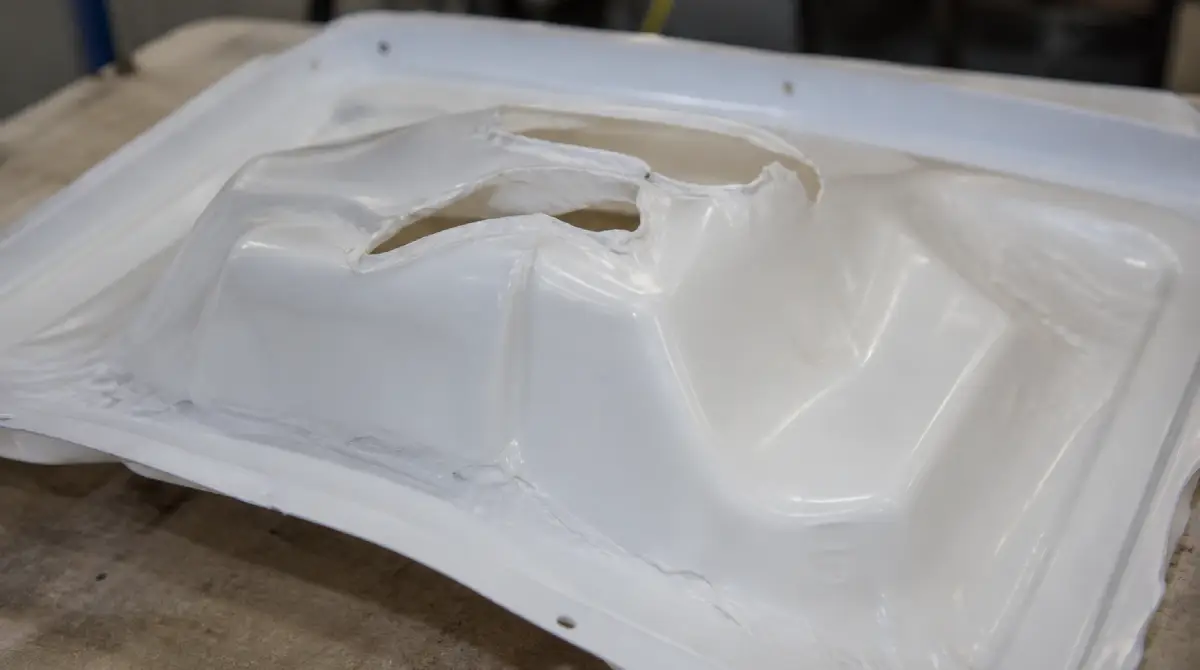
The vacuum forming disadvantages listed in every manufacturing comparison are real. Uneven wall thickness. Limited geometric complexity. Material waste. Separate trimming. These are not myths or edge cases. They are built into the physics of the process and they will show up in your production if you ignore them.
But here is what those comparisons miss: every one of these disadvantages is context-dependent. The same constraint that makes vacuum forming the wrong choice for a precision structural bracket makes it the only practical choice for a 1.5-meter automotive interior panel. Understanding where each limitation actually bites — and where it doesn't — is what separates engineers who use vacuum forming well from those who don't.
Below is a complete breakdown of vacuum forming disadvantages: geometric, material, economic, and process-related. For each one, the mechanism, the numbers, and the context in which it stops being a problem.
The Pressure Ceiling: Why Vacuum Forming Can Never Match Injection Molding Detail
The most fundamental limitation of vacuum forming is built into the physics of the process. The maximum force pressing plastic into a mold is atmospheric pressure: 101.3 kPa (14.7 PSI). That is the absolute ceiling, and nothing in your setup changes it.
Injection molding operates at 500 to 2,000 bar. That is two to three orders of magnitude higher. The direct consequence: vacuum forming physically cannot push a viscoelastic material into fine surface detail, sharp corners, or narrow channels the way injection does. Every geometric limitation discussed below flows from this single constraint.
Pressure forming partially addresses this by adding compressed air above the sheet at 2–6 bar. It improves detail reproduction and allows finer textures. But that is a different class of equipment at a different price point. Pure vacuum forming works with atmospheric pressure only.
Geometric Limitations: What Vacuum Forming Cannot Produce
Sharp Corners and Minimum Radii
Atmospheric pressure is not enough to force hot plastic into a sharp corner of a female mold. Every corner on a vacuum-formed part will have a radius. The working rule on the shop floor: minimum internal radius must be at least 1.5 to 2 times the sheet thickness. Ignore this and you get bridging, where the plastic spans across the corner without touching the mold wall. The geometry is off, tolerances are not held, and there is nothing you can adjust to fix it short of redesigning the mold.
Undercuts Are Essentially Off the Table
Classic vacuum forming cannot produce undercuts. Any part that is wider at the bottom than at the top, or has sidewall protrusions, will lock onto the mold. Injection molding solves this with side-action cores. In vacuum forming, the workarounds are segmented tooling or pneumatic inserts, both of which multiply tooling cost significantly and eliminate the low-cost-tooling advantage that makes vacuum forming attractive in the first place.
Draft Angles: Non-Negotiable
Every vacuum-formed part requires draft angles. Plastic shrinks as it cools and grips male molds tightly, creating a near-vacuum lock on smooth surfaces. Without draft, you cannot demold without damage.
| Mold Type | Minimum Draft Angle | What Happens Without It |
|---|---|---|
| Male (plug/positive) | 3-5°, up to 7° for deep draws | Scratching, deformation on release, mold damage |
| Female (cavity/negative) | 3–5° standard; 1.5–2° on smooth surfaces only | Incomplete seating, centering problems |
| Textured surface | +1° per 0.025 mm of texture depth | Material sticking in the texture pores |
These draft angles are not free: they eat into usable part volume and constrain vertical wall design.
Uneven Wall Thickness: The Core Engineering Problem
If there is one disadvantage that eliminates vacuum forming from structural applications, this is it. Wall thickness variation is inherent and largely uncontrollable without simulation software and plug-assist tooling.
When a sheet stretches, its area increases and thickness drops proportionally. That is simple conservation of mass. The problem is that thinning is extremely non-uniform. The moment hot plastic touches the cold mold surface, that contact zone cools below the forming temperature. Viscosity spikes. Stretching stops. Meanwhile, the rest of the sheet keeps pulling thinner.
Areas that contact the mold first, typically the top and edges, retain close to original thickness. Corners and the base, which the plastic reaches last, can be three to five times thinner than the average. In practice, predicting local thickness at any given point to better than plus or minus 20 percent accuracy requires computer simulation. This is why vacuum forming is not suitable for load-bearing parts where strength calculations matter.
Draw Ratio and When Things Break
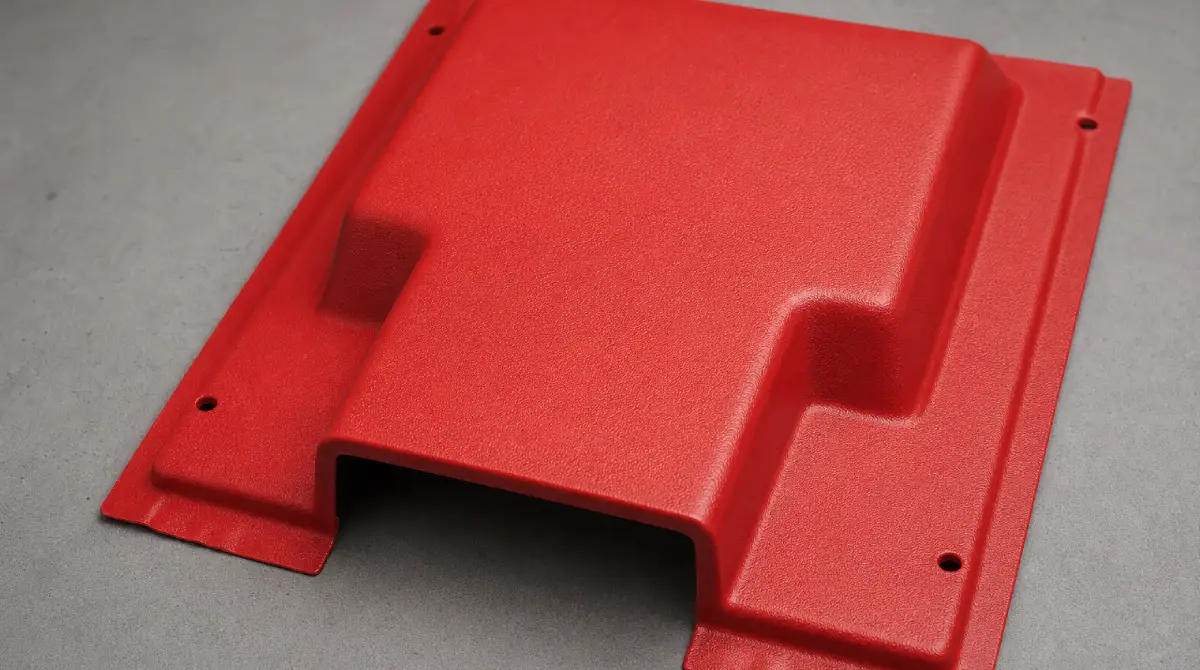
The linear draw ratio (depth divided by minimum width) should stay at or below 1:1 for standard vacuum forming without plug assist. Exceed that and base wall thickness becomes unacceptably thin. Plug assist pre-distributes material before vacuum is applied, pushing the practical limit higher.
| Material | Max ADR (no assist) | Max ADR (with plug assist) | Thinning Risk |
|---|---|---|---|
| HIPS | 3.0 : 1 | 5.0 : 1 | Low (good flow characteristics) |
| ABS | 2.5 : 1 | 4.0 : 1 | Medium (precise heat control needed) |
| PETG | 2.0 : 1 | 3.5 : 1 | High (cools fast) |
| PC (Polycarbonate) | 1.5 : 1 | 2.5 : 1 | Very high (narrow forming window) |
For a full breakdown of how material selection affects forming results, see how to choose the right plastic sheet for vacuum forming.
Residual Stress and Molecular Orientation
Stretching a polymer sheet aligns its molecular chains in the direction of draw. That creates anisotropy: the part is stronger along the draw direction and significantly weaker perpendicular to it. On the shop floor this shows up as parts that crack from side impacts in zones that look more than thick enough.
The second problem comes in service. When a formed part is exposed to heat, whether from sun, proximity to an engine, or a warm environment, those frozen stresses relax. The part warps, shrinks locally, and loses dimensional accuracy. For crystalline polymers like PP and HDPE, volumetric shrinkage from forming temperature to room temperature reaches 1.5 to 2.2 percent. Because vacuum cannot hold the material as firmly as steel tooling closing under tonnage, edge curl and geometry distortion on large flat panels are nearly unavoidable. For a detailed breakdown of how to prevent warping, see vacuum forming warping: causes and fixes.
Residual stress also makes parts sensitive to environmental stress cracking (ESC). Acetone, isopropyl alcohol, toluene, and even some essential oils can trigger immediate cracking in stressed polycarbonate or PMMA. Cleaning finished parts with the wrong solvent is a real and consistent failure mode.
Process Defects Specific to Vacuum Forming
Webbing Between Features
When two male features are placed too close together, excess sheet material between them folds back on itself. The sagging sheet has more perimeter than the mold in that zone, and the extra material has nowhere to go. The rule: spacing between adjacent male features must be at least 1.5 to 2 times the feature height. That spacing requirement directly reduces how efficiently you can use sheet area and drives up material cost per part.
Chill Marks
Visible lines appear where the sheet first contacted the mold or plug tool. These are not just cosmetic: the zone has different mechanical properties because viscosity spiked sharply at that point. On transparent parts from acrylic or PETG, any mold contamination, machining marks, or airborne dust transfers directly onto the part surface. That demands either near-clean-room conditions or precisely polished aluminum tooling. Plaster and wood molds are not an option for optical-quality surfaces.
Moisture Blistering
ABS, PC, PETG, acrylic, and nylon all absorb moisture from ambient air. When heated to forming temperatures of 160 to 220°C, that moisture flashes to steam, creating internal voids and surface bubbles. The part is scrap. The only fix is pre-drying: PC needs a minimum of 4 hours at 120°C per 3 mm of sheet thickness; ABS needs 2 to 4 hours at 80°C; PETG needs 2 hours at 65°C if stored in humid conditions. Brief exposure to open air after drying reintroduces enough moisture to cause the same problem. This adds hours to production setup and requires industrial drying ovens as essential equipment, not optional extras. For a full list of defects and fixes, see the vacuum forming troubleshooting breakdown.
Nipples from Vent Holes
Overheated, fluid plastic gets drawn into vacuum vent holes by atmospheric pressure, leaving small sharp protrusions on the part surface. Vent hole diameter must stay between 0.8 and 3.0 mm. If holes are oversized or the sheet is too hot, you get nipples that cannot be removed without leaving marks.
The Real Cost of Vacuum Forming: Where the Numbers Add Up
Sheet Stock vs. Pellet Pricing
Sheet plastic costs 20 to 40 percent more per kilogram than the same material in pellet form used for injection molding. Every unit of production carries that markup. The extruder who made the sheet already put energy and labor into it, and you pay for that.
Material Waste Is Substantial
The clamping flange around the perimeter of the sheet is always scrap. So are the spaces between parts in multi-cavity layouts. Depending on part geometry and nest efficiency, waste runs from 20 to 50 percent of sheet mass. Regrind is possible but requires grinding equipment, and recycled content degrades optical clarity and forming consistency.
Trimming Is a Separate Process
Unlike injection molding, where parts come off the press essentially finished, every vacuum-formed part needs trimming. That means separate equipment, separate fixturing, and separate labor.
| Trimming Method | Accuracy | Capital Cost | Limitations |
|---|---|---|---|
| Hand trim (knives, saws) | ±2.0 mm | Low | Inconsistent quality, injury risk |
| Die cutting (steel rule) | ±0.5 mm | Medium (die cost) | Thin sheet only, up to 3-4 mm |
| 5-axis CNC router | ±0.1 mm | Very high | Complex fixturing, programming time |
Designing and building trim fixtures often doubles total tooling cost. For short and medium runs, that investment rarely amortizes cleanly.
For a direct comparison of when vacuum forming makes sense against injection molding, see how vacuum forming actually works and where it fits in production.
Material Limitations: Not Every Thermoplastic Cooperates
Polycarbonate demands temperature accuracy within a 10°C window across its 160–190°C forming range. Go 10 degrees over and you get surface defects. Go 10 under and the part is underformed with high residual stress. Plus it needs pre-drying at 120°C for a minimum of 4 hours per 3 mm of thickness, every time.
Polypropylene has a shrinkage rate of 1.5 to 2.2 percent. On large flat panels without active mold cooling, warping is nearly guaranteed. PETG loses optical clarity faster than ABS or HIPS when overheated, with a tighter margin between the ideal forming temperature and the degradation point.
One thing from experience that catches people: only extruded acrylic (PMMA-ex) is suitable for vacuum forming with fine mold detail. Cast acrylic looks identical, but it has an extremely narrow plastic zone and will only drape into broad, shallow shapes. It cannot reproduce fine texture or deep draws. There is no visual way to tell them apart. You need the supplier data sheet.
Health, Safety, and Environmental Considerations
Volatile Organic Compound Emissions
Heating plastic to forming temperatures releases VOCs. PVC at overheat produces hydrochloric acid gas, which is toxic to personnel and corrodes metal machine components simultaneously. ABS releases styrene vapor. Running a forming shop without a powerful local exhaust ventilation system positioned directly above the heating zone is a genuine occupational health failure, not just a regulatory one.
Dust and Static Charge
Mechanical trimming of plastic generates fine dust. Plastic is electrostatically charged, so that dust settles on every surface in the shop, including mold faces, contaminating subsequent parts. The solution is industrial aspiration at the cutting station and ionizing air guns at the forming station. Both are additional cost and floor space.
Thermal Degradation During Process Failures
If a sheet overheats from a heater control failure, thermal decomposition begins. ABS decomposes with styrene and acrylonitrile release. PC and PMMA produce their own specific toxic breakdown products. Temperature sensors, thermal labels on the sheet, and a reliable emergency heater shutoff are not optional safety extras. They are baseline requirements.
How Vacuum Forming Compares to Alternatives

| Parameter | Vacuum Forming | Injection Molding |
|---|---|---|
| Tooling cost | Low ($3k-$30k) | Very high ($30k-$300k) |
| Geometric accuracy | ±0.5 to 2.0 mm | ±0.05 to 0.2 mm |
| Wall thickness control | Variable ±20-30% | Controlled ±5-10% |
| Best volume range | 100 to 10,000 units/yr | 10,000+ units/yr |
| Undercuts | Not without special tooling | Yes (side-action cores) |
| Material waste | 20-50% to trim scrap | Minimal (runner only) |
Vacuum forming occupies a specific niche: large thin-walled shells of moderate geometric complexity at medium volumes. Outside that niche, it concedes to alternatives on accuracy, waste, or unit economics.
When Vacuum Forming Disadvantages Don't Matter
The vacuum forming disadvantages above are real in the wrong application. In the right one, most of them become irrelevant or reverse into advantages. The applications where vacuum forming consistently outperforms alternatives:
| Application | Why Vacuum Forming Wins | Why Alternatives Lose |
|---|---|---|
| Large enclosures and covers (>500 mm) | Single-cycle forming, low tooling cost, fast lead time | Injection: tooling $50k+, clamping tonnage limits part size |
| Automotive interior panels | Complex surface geometry at low volume, A-surface quality on female mold | Injection: uneconomical below 20,000 units/yr |
| Medical trays and packaging | FDA-compliant materials, clean forming, low tooling cost for frequent design changes | Injection: tooling lead time 8–16 weeks vs 1–3 weeks for vacuum forming |
| Retail display and point-of-sale | Short runs, frequent design updates, transparent materials | Injection: over-engineered and over-priced for seasonal items |
| Prototyping and pre-production | Functional parts in production material in days, not months | Injection: first article takes 10–20 weeks minimum |
| Transport and agricultural equipment | Large thin-walled panels, impact-resistant materials, field-repairable | Injection: no practical way to form panels above 1 meter |
The pattern is consistent: wherever part size is large, volumes are moderate, design iterations are frequent, or tooling lead time matters, vacuum forming's disadvantages shrink to irrelevance. The process is not competing with injection molding on injection molding's terms. It occupies a production space that injection molding cannot reach at all.
FAQ: Vacuum Forming Disadvantages
Are vacuum forming disadvantages fixable with better equipment?
Some are, some are not. The pressure ceiling — 101.3 kPa maximum — is a physical constant that no equipment changes. Uneven wall thickness can be significantly reduced with zone-controlled heating, plug assist, and forming simulation software. Material waste is reduced by multi-cavity tooling and optimized nesting. Trimming accuracy is resolved with 5-axis CNC routing. The geometric limitations — no undercuts, mandatory draft angles, minimum corner radii — are inherent to the process and cannot be engineered away on standard equipment. On the right application, none of these require a fix because they simply do not affect the outcome.
Is vacuum forming accurate enough for industrial production?
Yes, for the applications it is designed for. Dimensional tolerance of ±0.5 to 2.0 mm is sufficient for enclosures, covers, panels, trays, and packaging — which together represent the majority of vacuum forming applications. It is not sufficient for precision mechanical parts, close-tolerance assemblies, or load-bearing components. Matching the process to the application is the decision. THERMOFORA machines running in 24 countries produce industrial-grade parts daily within these tolerances.
Why can't vacuum forming produce sharp corners?
The maximum pressure pressing plastic into a mold is atmospheric: 101.3 kPa (14.7 PSI). That is not enough to force a viscoelastic material into a sharp corner of the tool. Every corner will have a radius of at least 1.5 to 2 times the sheet thickness. This is a physical limit that no equipment setting or material choice eliminates.
Why does wall thickness vary so much in vacuum-formed parts?
When a sheet stretches, surface area increases and thickness drops proportionally. The freeze mechanism makes this non-uniform: the instant hot plastic contacts the cold mold, that zone stops stretching while the rest continues thinning. First-contact areas keep near-original thickness; corners and base, which the plastic reaches last, can be 3 to 5 times thinner than the sheet average. Predicting local thickness to better than plus or minus 20 percent requires computer simulation.
Why does vacuum forming generate so much material waste?
The clamping flange around the sheet perimeter always goes to trim scrap. Inter-cavity spacing in multi-part layouts adds more. Depending on part geometry and nesting, waste ranges from 20 to 50 percent of sheet mass. Injection molding waste is limited to the runner system, which is dramatically less. Regrind recovery adds cost and degrades forming consistency.
Which plastics are hardest to vacuum form?
Polycarbonate has a narrow forming window, mandatory pre-drying (120°C, minimum 4 hours per 3 mm), and high sensitivity to both overheating and residual stress. Polypropylene has 1.5 to 2.2 percent shrinkage, which causes warping on large flat panels without water-cooled tooling. PETG loses optical clarity faster than ABS on overheating. Cast acrylic looks identical to extruded but cannot reproduce fine mold detail or deep draws.
At what production volume does vacuum forming become uneconomical?
Below 100 to 200 units, tooling and trimming cost per part is too high. Above 10,000 to 20,000 units per year, injection molding typically wins on unit economics despite its higher tooling investment, because it produces zero trim waste and needs no separate finishing operation. The practical sweet spot for vacuum forming is 200 to 10,000 units, on parts whose geometry the process can actually handle.
Bottom Line: Vacuum Forming Disadvantages in Context
Related Reading
For a full overview of how the process works before evaluating its limits, see how vacuum forming works: process, materials, and tooling. If you are comparing materials for a specific application, see how to choose the right plastic sheet for vacuum forming. For warping issues specifically, see vacuum forming warping: causes and fixes. If you are already running production and dealing with defects, the full diagnostic breakdown is in the vacuum forming troubleshooting breakdown: 15 most common defects solved.
THERMOFORA Vacuum Forming Machines
Industrial vacuum forming machines — manufactured and ready to ship
From compact prototyping formats to full industrial sheet sizes. Every machine is built, tested, and shipped from our facility. Running in production across 24 countries.