
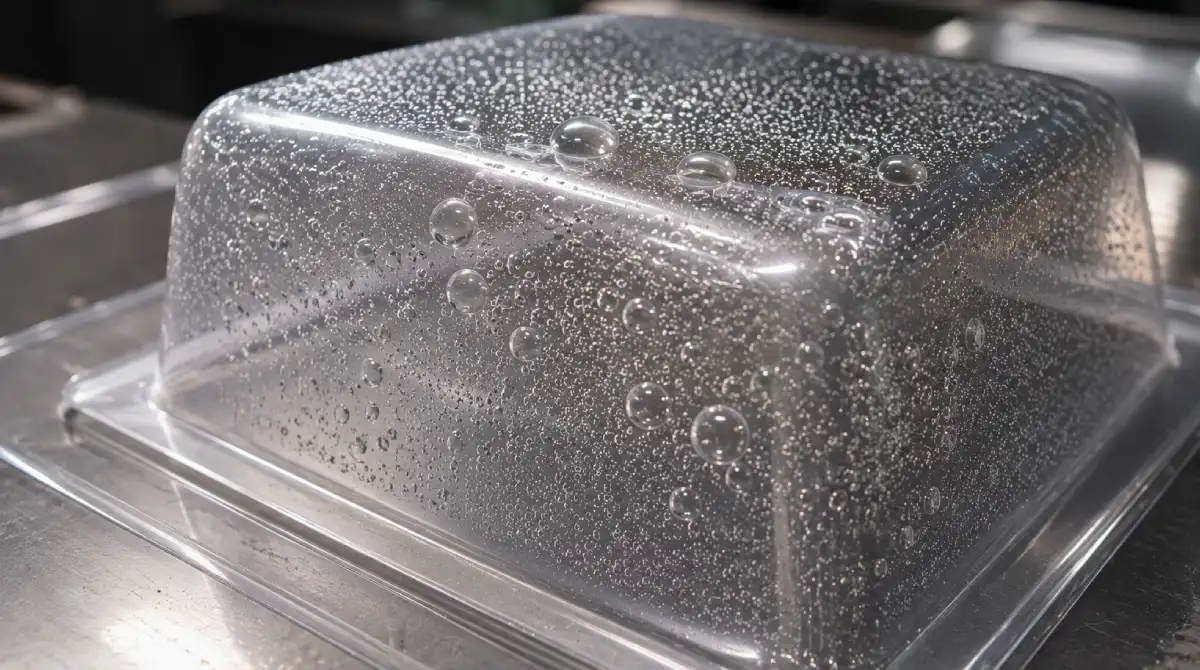
Blisters and Internal Bubbles
Moisture trapped within the plastic sheet vaporizes during heating, creating internal bubbles and blisters beneath the surface. As sheet temperature increases, vapor pressure rises and may exceed the polymer's melt strength. This causes localized expansion inside the material and can significantly weaken the formed part.
In severe cases, the expanding vapor ruptures the surface, producing a defect commonly known as a steam burst. Hygroscopic materials such as Polycarbonate (PC), ABS, and Acrylic are particularly susceptible because they absorb moisture from the surrounding environment during storage.
- Pre-dry hygroscopic materials before forming. Polycarbonate typically requires approximately 1 hour per millimeter of sheet thickness at 90°C.
- Reduce heating cycle time to prevent excessive vapor pressure buildup.
- Monitor bottom sheet temperature using an infrared (IR) sensor rather than relying solely on heater settings.
- Use staged pre-heating at approximately 60°C to allow moisture to escape gradually before reaching forming temperature.
- Store sheets in a dry environment and minimize exposure to humid conditions prior to processing.
THERMOFORA Vacuum Forming Machines
Industrial vacuum forming machines — manufactured and ready to ship
From compact prototyping formats to full industrial sheet sizes. Every machine is built, tested, and shipped from our facility. Running in production across 24 countries.