
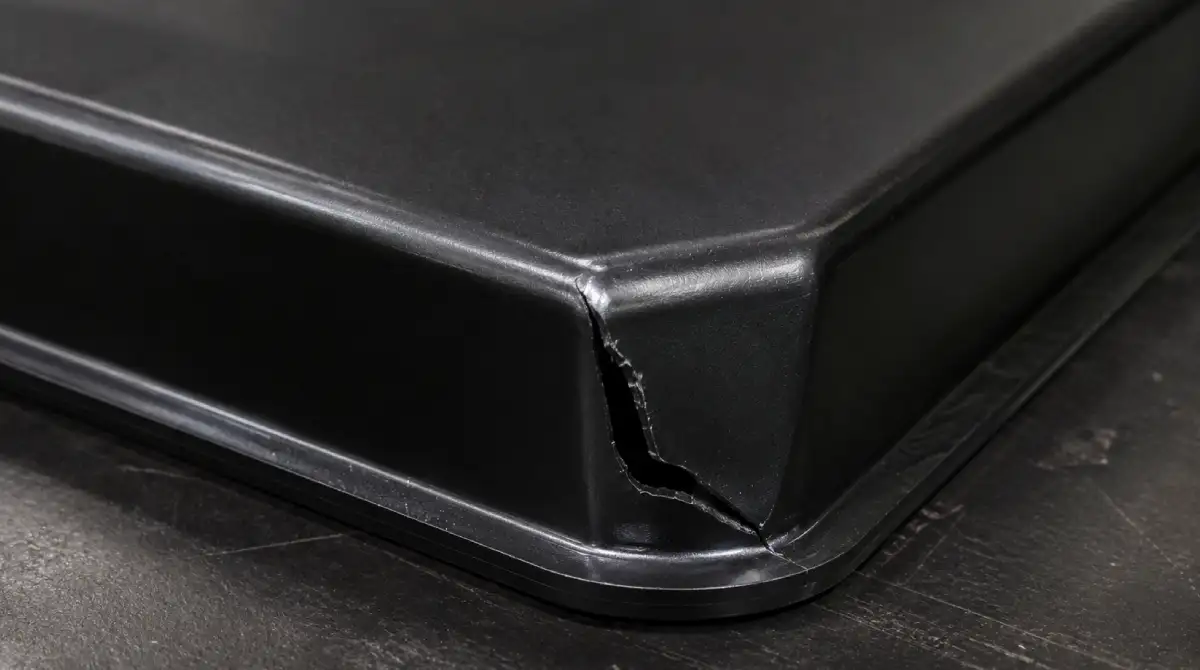
Corner Tearing from Over-softened Sheet
Corner tearing occurs when the plastic sheet has been heated beyond its optimal forming window. At that point tensile strength drops sharply — the material can no longer resist the mechanical stress of being stretched over a tight geometry. The failure almost always initiates at corners and edges where the sheet is forced to change direction abruptly, concentrating strain into a very small area. Deep-draw parts are especially vulnerable because the sheet travels a long path before it contacts the mold, giving the hottest zones even less resistance by the time forming begins.
The problem is compounded when mold corners have small radii. A sharp inside corner acts as a stress riser: the already-weakened material has to conform to a near-zero-radius geometry with no room to redistribute strain. On deep draws, wall thinning at corners can reach a point where the remaining thickness simply cannot carry the load, and the sheet splits rather than stretches.
- Reduce heat cycle time in small increments — 3–5 seconds at a time — until the sheet reaches forming temperature without becoming excessively fluid or losing structural integrity.
- Verify sheet surface temperature with an IR pyrometer before forming. Most ABS and HIPS work well in the 150–165°C range; exceeding the upper limit is the primary driver of over-softening tears.
- Increase corner radii in the mold to a minimum of 3–5 mm on inside corners. Larger radii distribute strain over a greater surface area and reduce peak stress at any single point.
- Use a plug assist on deep-draw sections to pre-stretch the sheet evenly before vacuum is applied, reducing the amount of forming work the vacuum has to do at the corners.
- Check for uneven heating across the sheet — hot spots near heater edges or gaps in the element array can create localized over-softened zones even when average temperature looks correct.
- For PP and HDPE, apply an additional 1–2° draft angle to corners alongside the radius increase; both materials have high shrinkage and resist conforming to tight geometry even at correct temperatures.
THERMOFORA Vacuum Forming Machines
Industrial vacuum forming machines — manufactured and ready to ship
From compact prototyping formats to full industrial sheet sizes. Every machine is built, tested, and shipped from our facility. Running in production across 24 countries.