
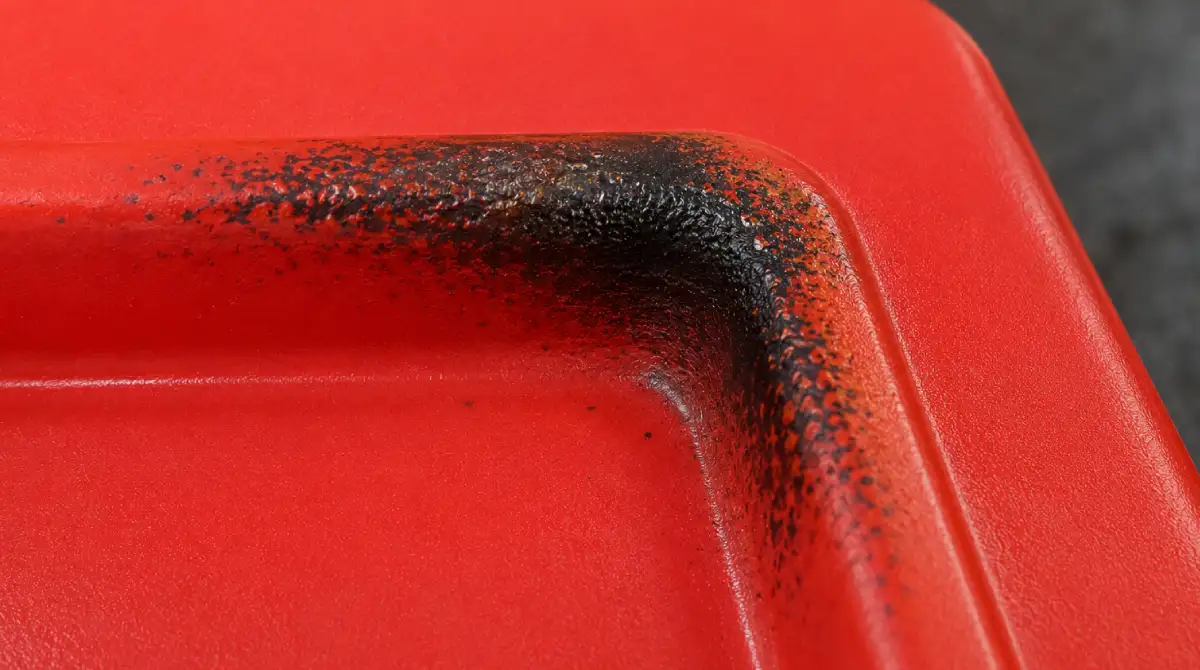
Material Burning
Material burning is the result of unchecked thermal energy accumulation in the sheet, pushing the polymer past its degradation threshold rather than just its forming temperature. When IR heater output exceeds what the material can absorb uniformly, localised surface zones reach decomposition temperature while the sheet core is still heating. The visible outcome — bubbling, charring, or brown-to-black scorching — is a sign of irreversible polymer chain breakdown, not just surface discolouration. ABS is particularly prone to yellowing and surface blistering at temperatures above 190°C; PC develops brown streaks and surface cracks; PVC releases HCl gas before visible charring appears.
Faulty or mismatched heater zones are a primary driver. A single failed IR element forces adjacent zones to compensate, creating uneven flux across the sheet. Heater-to-sheet distance that is too close, incorrect heater wavelength for the material, or an excessively long dwell time with no temperature feedback all compound the risk. On older machines without closed-loop temperature control, the operator relies entirely on visual sag cues — which appear well after surface burning has already initiated in thin-gauge material.
- Inspect all heater zones for faults. Visually check IR elements at startup — a failed element appears dark or unevenly lit. Use an IR thermometer or thermal camera to map the heat distribution across the platen before forming. Replace any element showing output deviation greater than 10% from its rated output.
- Reduce oven temperature setpoints by material grade. Work within the confirmed forming window: ABS 150–170°C, HIPS 140–165°C, PC 160–190°C. If burning occurs within the normal range, the actual sheet surface temperature is higher than the setpoint — recalibrate with a contact pyrometer directly on the sheet surface mid-cycle.
- Shorten heating cycle in 3–5 second increments. Burning often appears at the correct temperature but with dwell time that is 10–20% too long. Reduce cycle time progressively until scorch marks disappear while maintaining adequate sag for forming depth.
- Increase heater-to-sheet distance. If the platen is set closer than manufacturer specification, the radiant flux per unit area increases sharply. Even a 10–15 mm increase in distance can meaningfully reduce surface flux without significantly extending cycle time.
- Switch to medium-wave IR for sensitive materials. Short-wave heaters below 1 µm penetrate the surface aggressively and can cause subsurface bubble formation before the operator sees any sag. Medium-wave elements at 2.4–4.0 µm provide more controlled, surface-safe heating for PC, PMMA, and optically sensitive materials.
- Implement closed-loop temperature control. If the machine lacks feedback control, add a non-contact IR sensor above the sheet that cuts heater output once a target surface temperature is reached. This eliminates runaway heating caused by ambient temperature fluctuations or varying sheet colour and thickness between batches.
THERMOFORA Vacuum Forming Machines
Industrial vacuum forming machines — manufactured and ready to ship
From compact prototyping formats to full industrial sheet sizes. Every machine is built, tested, and shipped from our facility. Running in production across 24 countries.