
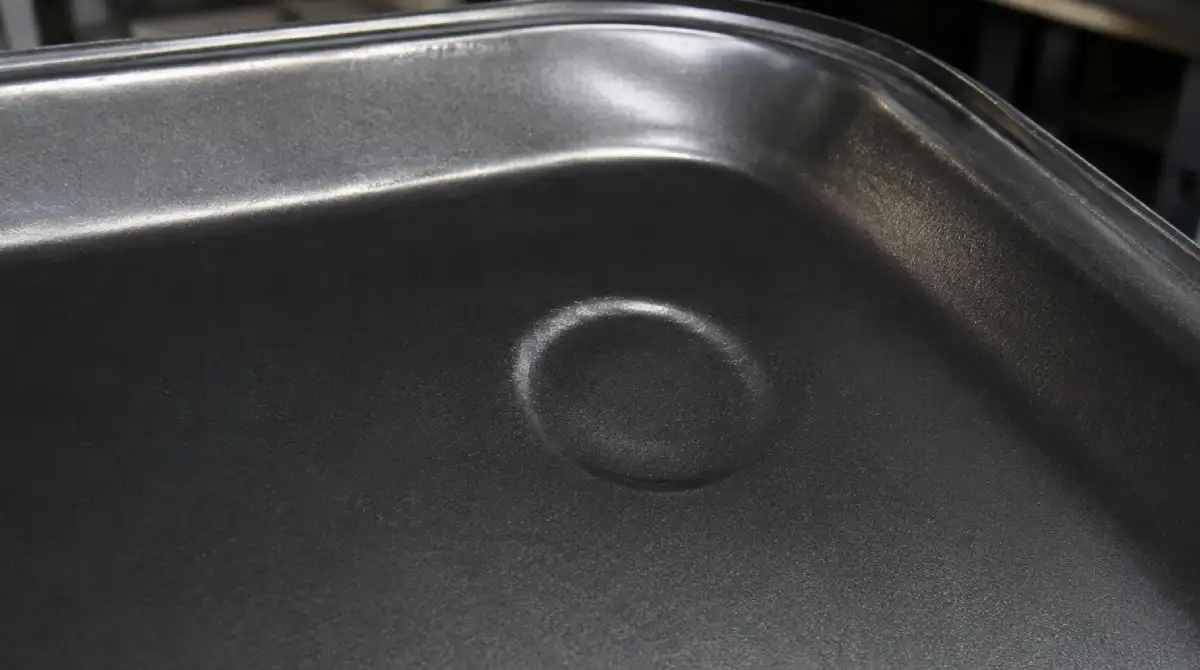
Plug Mark Imprint
Plug mark imprint occurs when the thermoplastic sheet is heated beyond its optimal forming window, causing the surface layer to become excessively fluid. At this viscosity, even light mechanical contact — such as the initial touch of a plug assist — is sufficient to permanently displace material. The impression is set instantaneously because the overly soft sheet cannot recover elastically before the plug withdraws. Contributing factors include non-uniform IR panel output, incorrect thermocouple placement, and sag-based heating control systems that overshoot target temperature on thinner gauges.
In multi-zone ovens, localized overheating directly above the plug trajectory creates a soft spot that is disproportionately vulnerable. Plug geometry also plays a role: sharp-shouldered plugs with low taper angles concentrate contact stress over a smaller area, amplifying imprint depth. Materials with a narrow processing window — such as semi-crystalline HDPE or high-impact HIPS at the upper end of their range — are especially susceptible to this defect when cycle time is not tightly controlled.
- Wrap the plug in felt or flannel. A textile sleeve acts as a thermal buffer and distributes contact force across a larger surface area, preventing localised stress concentration at first touch. Use heat-resistant wool felt rated above forming temperature.
- Reduce heating time or lower heater output. Decrease oven dwell time in 2–3 second increments or reduce upper zone output by 5–10% until the sheet retains enough melt strength to resist plug contact without deformation.
- Delay plug entry. Introduce a 0.5–1.0 second pause between mould close and plug advance so the outermost sheet surface cools slightly and recovers partial rigidity before mechanical contact occurs.
- Reduce plug advance speed. Slower plug travel reduces impact force and gives the sheet more time to conform gradually rather than receiving a sudden localised load at contact point.
- Review plug shoulder geometry. Replace plugs with sharper shoulders with designs featuring a larger contact radius or chamfer to spread the initial contact load over a wider area of the sheet.
- Profile upper zone heaters independently. Use pyrometer or IR camera data to identify overheated zones in the plug contact region and reduce those specific heater outputs to balance the temperature profile across the sheet.
THERMOFORA Vacuum Forming Machines
Industrial vacuum forming machines — manufactured and ready to ship
From compact prototyping formats to full industrial sheet sizes. Every machine is built, tested, and shipped from our facility. Running in production across 24 countries.