
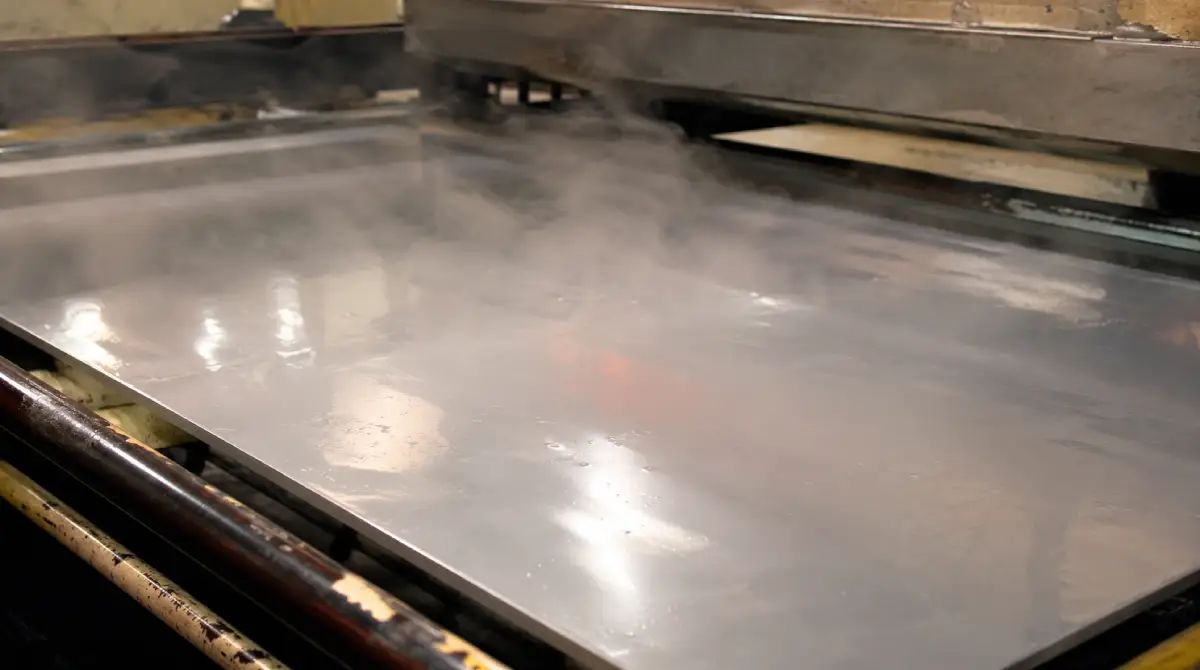
Polymer Degradation Odor
Polymer degradation odor is not a surface defect — it is a chemical signal that the material has been heated past its degradation threshold, triggering molecular scission: the irreversible breaking of polymer backbone chains into shorter fragments and free monomers. In styrenic materials — ABS, HIPS, and general-purpose polystyrene — this releases styrene monomer, which has a sharp, sweet-plastic odour detectable at very low concentrations. The smell appears before visible burning or charring, making it an early warning sign that the heat cycle is running too hot even when the sheet looks acceptable.
Molecular scission is permanent. Parts formed from degraded material will have measurably lower impact strength, reduced elongation at break, and increased brittleness compared to correctly processed stock — even if they appear visually identical. In ABS, the butadiene rubber phase degrades first, producing a sharper smell and a visible yellowing of the matrix. PVC releases hydrogen chloride gas at degradation temperatures, producing an acrid chlorine odour that is chemically distinct from styrenic fumes and requires different ventilation handling. Repeated exposure to degradation conditions compounds the molecular weight loss with each cycle on re-ground or regrind-blended sheet.
- Treat odor as a process alarm, not a nuisance. The moment degradation smell appears, stop the run and recalibrate the heat cycle before continuing. Parts produced during a degradation event should be quarantined and tested for mechanical properties before release — visual inspection alone is insufficient to confirm part integrity after overheating.
- Reduce oven temperature and verify with contact pyrometry. Lower setpoints to bring the sheet surface below the degradation threshold for the specific material: ABS degrades above 270°C, HIPS above 260°C, PS above 250°C, PVC above 170°C. Measure actual sheet surface temperature mid-cycle with a contact pyrometer or IR thermometer — controller setpoints frequently diverge from actual surface temperature by 15–30°C due to calibration drift and ambient variation.
- Shorten heating cycle in 5-second decrements. If setpoints are already within range, dwell time is the more likely cause. Reduce cycle time progressively until odor disappears while maintaining adequate sag for the forming geometry. Log the corrected cycle time per material grade and thickness for future reference.
- Install or upgrade local exhaust ventilation at the oven opening. A capture hood positioned 200–300 mm above the oven exit point removes fumes at source before they disperse into the work area. Exhaust air volume should achieve at least 10 air changes per hour in the forming zone. For PVC specifically, install activated carbon filtration on the exhaust stream — styrenic fumes from ABS and HIPS are less acutely hazardous but still require adequate dilution ventilation per local occupational exposure limits.
- Check heater zone calibration and element condition. A single over-performing heater element running above rated output can drive localised surface temperatures into the degradation range even when the overall setpoint is correct. Use an IR camera to map heater output uniformity across the platen and replace any element showing output deviation greater than 10%.
- Avoid regrind-heavy blends on temperature-sensitive runs. Regrind material has already experienced one or more heat cycles and has a reduced molecular weight baseline. Blending high regrind ratios (above 20–25%) with virgin stock lowers the effective degradation threshold of the blend. For quality-critical runs, use virgin material only and reserve regrind for secondary or non-structural applications.
THERMOFORA Vacuum Forming Machines
Industrial vacuum forming machines — manufactured and ready to ship
From compact prototyping formats to full industrial sheet sizes. Every machine is built, tested, and shipped from our facility. Running in production across 24 countries.