
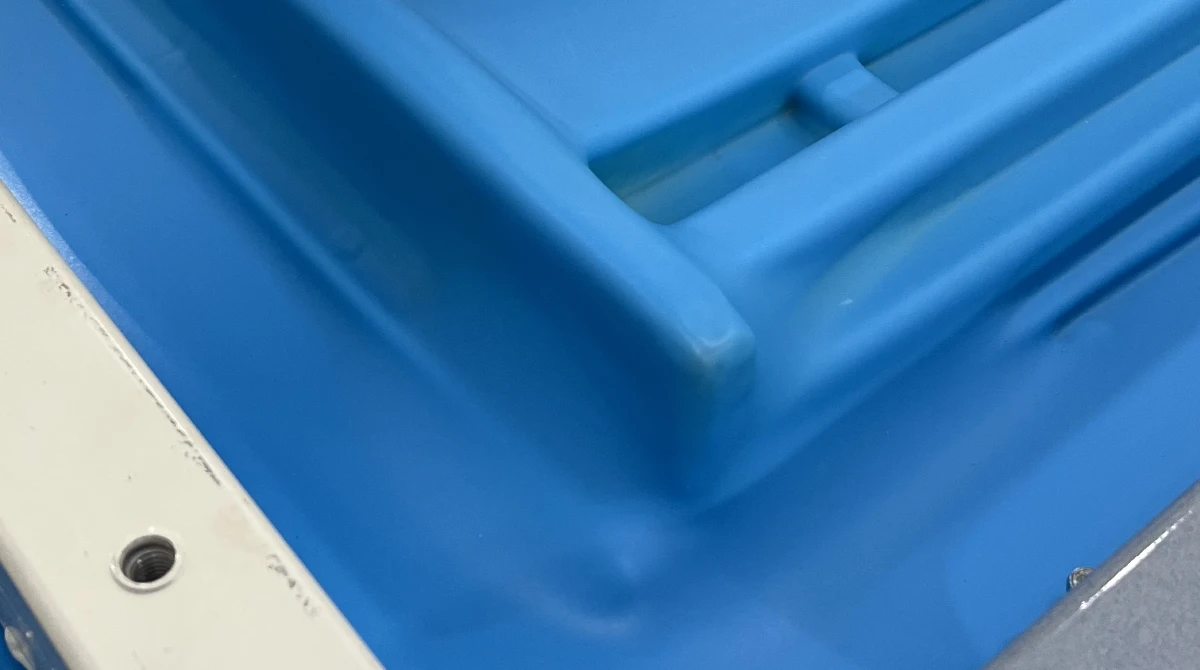
Poor Detail Reproduction
Poor detail reproduction occurs when the thermoplastic sheet enters the forming cycle below its elasto-plastic range — the temperature window in which the material has sufficient melt flow to conform to fine mold geometry under vacuum pressure. Below this threshold, the sheet retains too much elastic memory and structural rigidity to be drawn into sharp corners, fine textures, lettering, or tight radii. The vacuum pressure differential (typically 0.8–0.95 bar in standard machines) is insufficient to overcome the sheet's resistance, resulting in rounded edges, shallow texture depth, incomplete corner contact, and geometry that reads as soft or blurred compared to the mold surface.
A secondary but equally important cause is the speed of air evacuation. Even a correctly heated sheet begins cooling the instant it contacts the cold mold surface. If air removal is slow — due to insufficient vacuum pump capacity, undersized vent holes, or absence of a vacuum receiver — the sheet loses temperature and stiffens before full mold contact is achieved. Detail reproduction failure in this case is not a heating problem but a forming speed problem: the material was at the right temperature but the evacuation cycle was too slow to capitalise on it. Cold molds compound this further — a mold at ambient temperature extracts heat from the sheet contact surface within the first 1–2 seconds, freezing geometry before vacuum draw is complete.
- Increase heater temperature or extend cycle time. Raise the forming temperature to bring the sheet fully into its elasto-plastic range. Increase oven setpoint in 5°C increments or extend dwell time in 3–5 second steps, forming a test piece after each adjustment. Target temperatures by material: ABS 150–170°C, HIPS 140–165°C, PC 160–190°C, PETG 130–160°C. Confirm actual sheet surface temperature with a contact pyrometer — setpoint alone is not a reliable indicator.
- Install a vacuum receiver to accelerate air evacuation. A vacuum receiver (surge tank) pre-charged by the vacuum pump stores a volume of evacuated air that is released instantly when the forming valve opens — delivering the full pressure differential to the mold cavity in under 0.5 seconds rather than the 2–4 seconds a direct-pump system requires. Faster evacuation means the sheet is drawn into mold geometry while still at peak temperature, before surface cooling begins. This is one of the highest-impact upgrades for detail reproduction on existing machines.
- Thermally condition the mold. Heat the mold to 40–70°C using embedded cartridge heaters, hot water channels, or external pre-heating before production begins. A conditioned mold slows the rate of heat extraction from the sheet surface at contact, extending the window during which the plastic remains fluid enough to conform to fine geometry. This is particularly effective for deep-draw parts, textured surfaces, and materials with narrow forming windows such as PC and PMMA. Mold temperature should be stabilised before the first production cycle — allow 20–30 minutes of conditioning time after reaching setpoint.
- Increase vent hole density in fine-detail zones. In areas with tight geometry — lettering, fine texture, sharp corners — air trapped between the sheet and mold surface resists evacuation and prevents full contact. Add additional vent holes at 0.8–1.0 mm diameter directly at the base of these features. Concentrated venting in detail zones reduces the residual air cushion that prevents the sheet from seating fully against the mold surface.
- Verify vacuum pump capacity against mold volume. Undersized pumps cannot achieve the required pressure differential quickly enough for the mold cavity volume. Calculate required pump displacement (m³/h) based on mold cavity volume and target evacuation time. If pump capacity is marginal, a receiver tank is the most cost-effective solution — it decouples peak flow demand from pump continuous output.
- Switch to a female (negative) mold for critical detail surfaces. In male (positive) tooling, the detail surface is on the outside of the part and the sheet must stretch over the geometry — detail reproduction depends entirely on pressure and temperature. In female tooling, the sheet is drawn into the cavity and atmospheric pressure presses it against the detail surface from behind, improving contact force and reproduction quality for fine features.
THERMOFORA Vacuum Forming Machines
Industrial vacuum forming machines — manufactured and ready to ship
From compact prototyping formats to full industrial sheet sizes. Every machine is built, tested, and shipped from our facility. Running in production across 24 countries.