
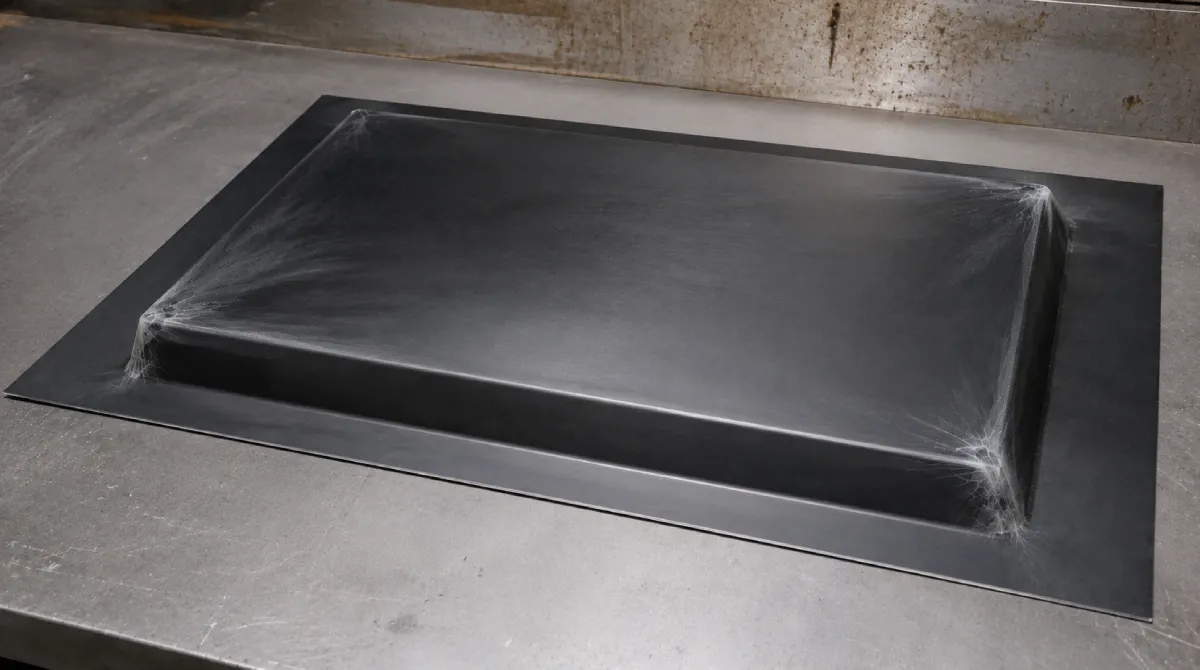
Stress Whitening
Stress whitening is caused by localised micro-cracking and excessive molecular orientation within the sheet at zones of high strain. When a thermoplastic sheet is stretched below its optimal forming temperature, the polymer chains cannot flow freely to accommodate the imposed deformation — instead they orient under tension and, at higher strain levels, create microscopic voids and crazes within the material structure. These voids scatter light, producing the characteristic white or opaque appearance at corners, radii, and deep-draw zones. The defect is irreversible: once micro-cracks form, the affected area has permanently reduced mechanical properties — lower impact strength and increased susceptibility to cracking in service — regardless of its visual appearance after cooling.
Three distinct triggers produce the same outcome. First, underheated sheet: material that has not reached its full elasto-plastic range resists deformation and stress-whitens at strain levels that a correctly heated sheet would accommodate without damage. Second, a cold plug assist: the plug contacts the sheet surface before vacuum draw and locally chills the contact zone below forming temperature — the sheet then stretches from a cold starting point in exactly the area of highest mechanical demand. Third, premature demolding: removing the part from the mold before it has cooled sufficiently releases residual forming stresses while the material is still above its heat distortion temperature, triggering post-form whitening at stressed zones that appeared acceptable immediately after forming.
- Increase sheet forming temperature. Raise oven dwell time in 3–5 second increments or increase heater output by 5°C steps until stress whitening disappears at the affected zones. The sheet must be fully within its elasto-plastic range before forming begins — partial heating produces uneven strain distribution that concentrates stress at the coldest zones, which are typically the corners and deepest draw areas. Verify surface temperature with a contact pyrometer rather than relying on controller setpoints.
- Pre-heat the plug assist to 50–80°C. A cold plug is a localised chilling device applied at the moment of maximum material strain. Heat the plug using embedded cartridge heaters or by pre-conditioning in an oven before the first cycle. Wrap the plug surface in wool felt to act as a thermal buffer — felt slows heat transfer from the sheet to the plug, maintains contact zone temperature longer, and distributes contact force over a wider area, all of which reduce stress concentration at first touch.
- Increase platen closing speed. Faster mold closure reduces the time between sheet leaving the oven and vacuum draw beginning — minimising heat loss before forming. On machines with adjustable platen speed, increase closing velocity to the maximum that maintains dimensional stability. Combined with a vacuum receiver for instantaneous evacuation, faster closure can significantly reduce the forming window deficit on marginal heat cycles.
- Apply stronger vacuum for faster draw. Higher vacuum differential — achieved by a larger pump, a receiver tank, or reduced system leakage — draws the sheet into mold contact faster, completing the forming stroke before temperature drops into the stress-whitening range. Check system vacuum level at the mold face under forming conditions; values below 0.7 bar indicate pump undersizing or system leakage that should be resolved before adjusting other parameters.
- Allow sufficient cooling time before demolding. The part must cool below its heat distortion temperature before it is removed from the mold. For ABS this is typically 80–90°C, for HIPS 70–80°C, for PC 120–130°C. Forced air cooling directed at the part surface while still on the mold accelerates cycle time without the stress release that causes post-form whitening. Do not use water cooling on parts still under residual forming stress — the thermal shock can initiate additional micro-cracking.
- Redesign mold geometry to reduce draw ratio at critical zones. If stress whitening persists at specific corners or deep zones despite correct process parameters, the draw ratio at those locations may exceed what the material can accommodate without micro-cracking. Increase corner radii to a minimum of 3–5× sheet thickness, add draft angles of at least 3–5°, or split deep geometry across multiple forming steps to distribute strain more evenly across the sheet.
THERMOFORA Vacuum Forming Machines
Industrial vacuum forming machines — manufactured and ready to ship
From compact prototyping formats to full industrial sheet sizes. Every machine is built, tested, and shipped from our facility. Running in production across 24 countries.