
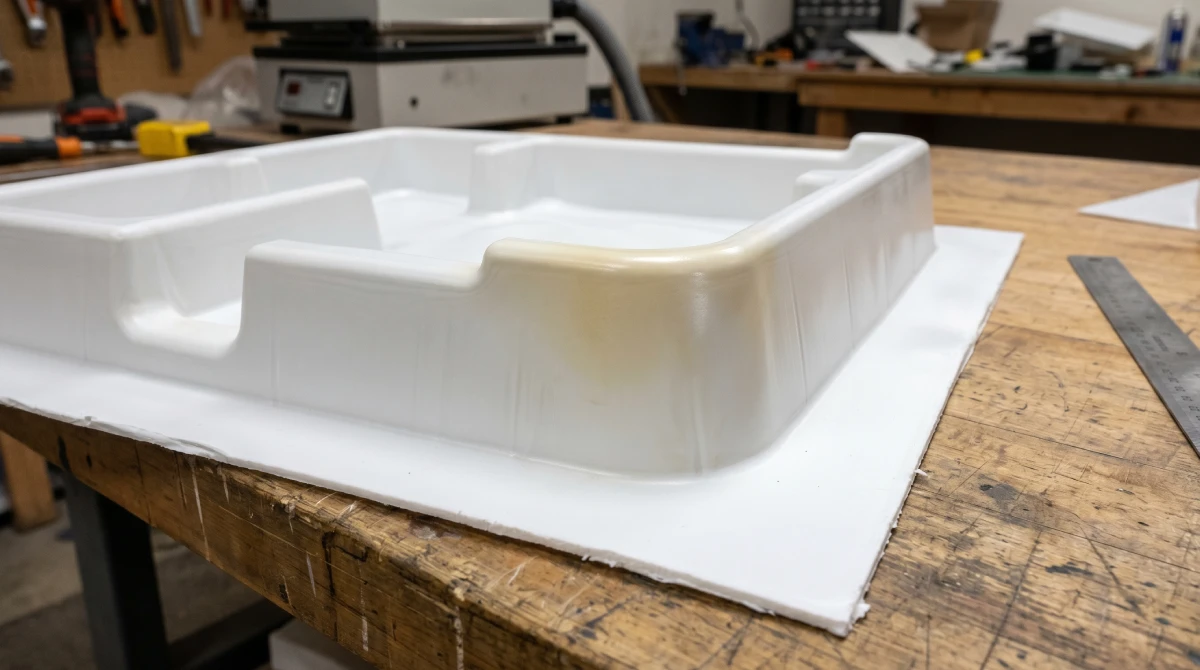
Surface Discoloration
Surface discolouration in thermoforming is caused by thermal instability — the point at which heat input exceeds what the polymer's stabiliser package can neutralise, triggering oxidative and thermal degradation reactions that alter the material's chromophore structure. In ABS, the acrylonitrile component oxidises to produce yellow-to-brown pigmentation; the butadiene rubber phase crosslinks and darkens simultaneously. In HIPS, styrene oxidation produces a characteristic amber yellowing that intensifies with repeated heat exposure. PVC is the most temperature-sensitive of the three: dehydrochlorination begins as low as 140°C in unstabilised grades, producing conjugated polyene sequences that shift colour from white through yellow, orange, and ultimately black as the degradation front advances.
Discolouration is irreversible — it cannot be corrected after forming. It also does not appear uniformly: uneven IR heater output, hot spots near element junctions, and zone boundary effects create patchy discolouration patterns that make affected parts visually inconsistent even within a single run. Light-coloured and natural-grade materials are most revealing — yellowing is imperceptible on dark pigmented stock but renders white, cream, or transparent parts cosmetically unacceptable. Regrind content amplifies susceptibility because previously heat-cycled material has depleted stabiliser reserves and degrades at lower temperatures than virgin stock.
- Reduce heating time as the primary corrective action. Shorten oven dwell time in 3–5 second decrements until discolouration disappears. Discolouration onset temperature is fixed by the material's stabiliser system — the only process variable the operator can control is how long the sheet spends near that threshold. Reducing time at temperature is more effective than reducing setpoint alone, because thermal mass means the sheet continues heating after the heaters cycle off.
- Obtain and work within the supplier's thermal stability data. Request the material's processing data sheet and identify the maximum recommended forming temperature and maximum exposure time at that temperature. For PVC, request the specific stabiliser system type (calcium-zinc, tin-based, or lead-free) as each has a different effective ceiling. Do not assume stability data from one grade transfers to another — reformulated grades within the same product family can have meaningfully different thermal windows.
- Map heater zone uniformity with an IR camera. Patchy discolouration that follows a grid or stripe pattern indicates uneven heater output rather than a global temperature problem. Identify overperforming elements and reduce their output individually. Replace elements showing greater than 10% deviation from rated output — a single faulty zone can create a discolouration band across every part in a run.
- Limit regrind content on cosmetically critical runs. For white, natural, or transparent material where discolouration is immediately visible, restrict regrind blending to 10–15% maximum and use only first-pass regrind. Material that has been through two or more heat cycles should not be blended into cosmetically sensitive stock regardless of its visual appearance at the time of blending.
- Separate upper and lower heater zone setpoints. If the machine supports independent zone control, run the upper zone 5–10°C cooler than the lower zone. The top sheet surface faces the upper IR elements directly and heats faster than the bulk — a lower upper zone output reduces peak surface temperature without reducing overall heat penetration into the sheet.
- Increase heater-to-sheet distance on the upper platen. For machines with adjustable platen height, increasing upper heater distance by 10–20 mm reduces radiant flux at the sheet surface and lowers peak temperature without changing wattage settings. Compensate with a modest cycle time extension if sag depth is affected.
THERMOFORA Vacuum Forming Machines
Industrial vacuum forming machines — manufactured and ready to ship
From compact prototyping formats to full industrial sheet sizes. Every machine is built, tested, and shipped from our facility. Running in production across 24 countries.