
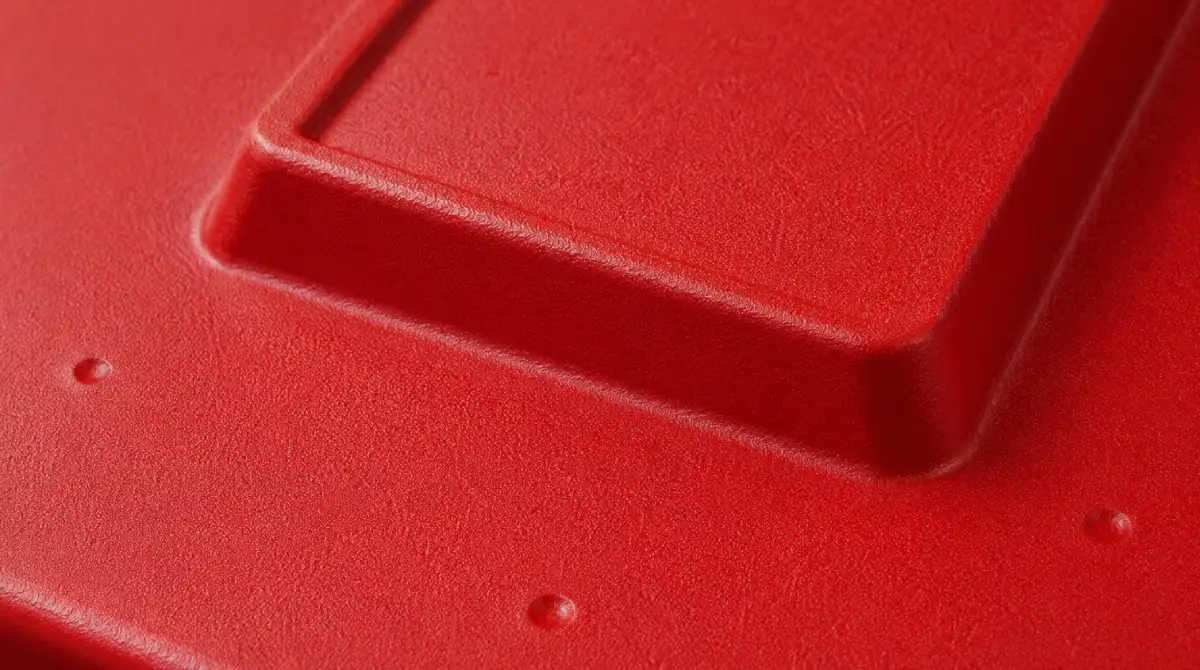
Nipples from Vent Holes
Nipple defects occur when the thermoplastic sheet is heated beyond its optimal forming window, reaching a melt viscosity low enough for atmospheric pressure to physically push the material into the mold's vacuum vent holes. As vacuum is applied, the pressure differential between the mold cavity and the atmosphere drives the overly fluid plastic into any available opening — including the vent holes drilled into the mold surface. The result is a small conical or cylindrical protrusion on the part surface at each vent location.
Oversized vent holes dramatically amplify this effect. Industry standard for vacuum vent diameter is 0.3 mm to 1.0 mm (1/32" to 1/8"), sized to allow air evacuation without permitting material ingress. When holes are drilled larger — due to worn tooling, re-drilling, or incorrect specification — even material at moderate temperatures can be drawn in. Sheet gauge and material type also matter: thin-gauge HIPS and ABS are more susceptible than thicker PC or HDPE sheets at equivalent temperatures.
- Reduce the heating cycle duration and temperature. The primary fix is restoring the sheet to a viscosity high enough to bridge vent holes under vacuum pressure. Reduce oven dwell time in 5-second increments and monitor forming quality until nipples disappear without compromising draw depth.
- Maintain vent hole diameter within 0.3–1.0 mm. Measure existing vent holes with a pin gauge. Any hole exceeding 1.0 mm must be addressed — drilling larger to "improve airflow" is a common mistake that worsens this defect significantly.
- Plug and re-drill oversized vent holes. Fill oversized holes with an appropriate filler (epoxy, aluminum plug, or welded material for aluminum tooling), allow full cure, then re-drill to the correct specification. Do not rely on tape as a permanent fix.
- Increase vent hole count rather than diameter. If airflow is insufficient and causing slow evacuation, add more vent holes at the correct diameter rather than enlarging existing ones. Concentrate additional vents in deep-draw areas and sharp corners where air entrapment is most likely.
- Consider vent hole position relative to geometry. Place vents at the lowest points of the mold cavity relative to vacuum draw direction — where air naturally collects last. Vents in flat highly-visible zones create cosmetically critical defect locations.
- Check material consistency across sheet batches. Batch-to-batch variation in melt flow index can shift the forming temperature window. If nipples appear after a material batch change with no process adjustment, recalibrate the heating profile for the new batch.
THERMOFORA Vacuum Forming Machines
Industrial vacuum forming machines — manufactured and ready to ship
From compact prototyping formats to full industrial sheet sizes. Every machine is built, tested, and shipped from our facility. Running in production across 24 countries.