
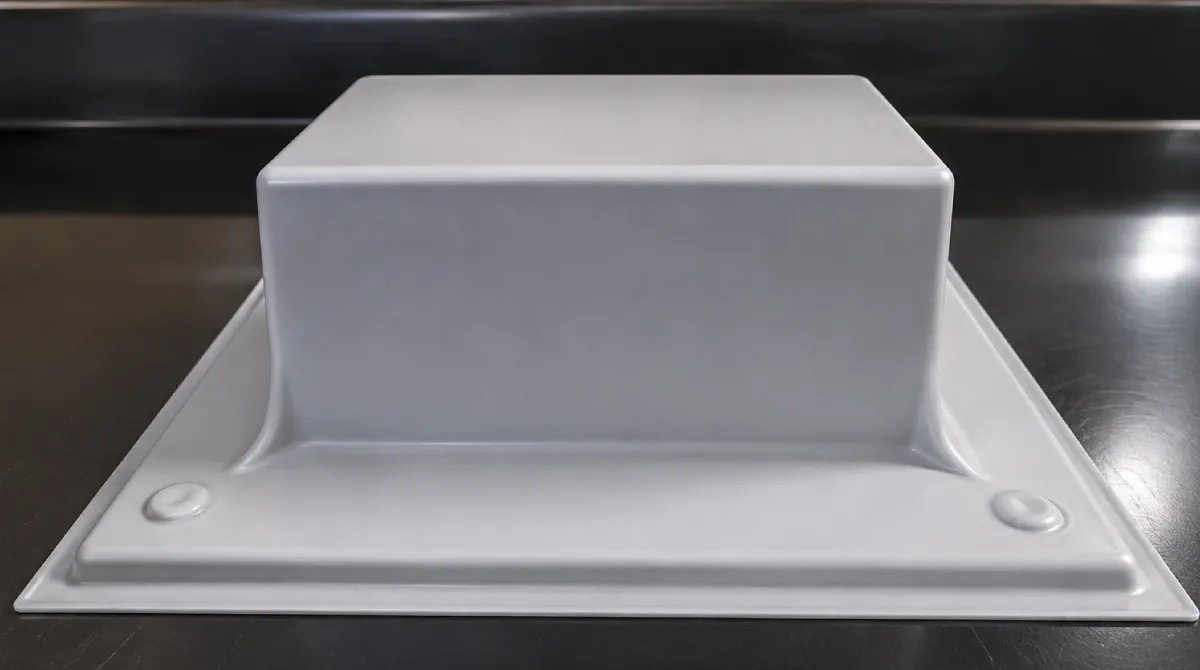
Webbing
Webbing occurs when there is more sheet material between mold features than the forming geometry can absorb — the excess folds back on itself, creating fins, drapes, or collapsed folds of plastic between cavities or around mold perimeters. The root cause is a mismatch between the volume of material presented to the forming zone and the surface area the mold geometry can accept. Three distinct conditions produce this mismatch. An underheated sheet lacks the melt flow to distribute evenly under vacuum — it draws unevenly, with material piling up between features rather than stretching uniformly into each cavity. A pre-stretch bubble that is too shallow fails to pre-distribute the sheet volume before mold contact, leaving excess material concentrated at inter-cavity zones. Cavities spaced too closely together create a geometry where the sheet cannot transition cleanly from one cavity wall to the next — it bridges the gap and collapses into a fold.
Webbing is particularly pronounced on multi-cavity tools forming deep parts, where the ratio of inter-cavity land area to part height is low. The 1.75× rule — minimum cavity edge-to-edge spacing equal to 1.75 times the part height — exists precisely to provide enough sheet travel distance for material to transition between cavities without folding. Below this threshold, webbing becomes structurally inevitable regardless of heating or pre-stretch optimisation. Sheet thickness also plays a role: thicker gauges have greater bending stiffness and are more prone to webbing at marginal spacing, while thin gauges may web due to insufficient material stiffness to resist collapse between features during the forming stroke.
- Optimise the heating profile for uniform sheet temperature. Webbing caused by uneven material distribution under vacuum is often a heating uniformity problem rather than a temperature level problem. Map heater zone output with an IR camera and identify cold zones in the inter-cavity regions — these are the areas where material stacks up. Increase output in those specific zones or extend dwell time until the sheet reaches a uniform elasto-plastic state across its full surface before forming begins.
- Increase pre-stretch air pressure and timing. Pre-stretching the sheet into a bubble before mold contact pre-distributes material volume away from inter-cavity zones and toward the areas of highest draw demand. Increase air pressure in 0.05 bar increments until the bubble height reaches approximately 60–80% of the deepest part height on the tool. Timing is equally important — the bubble must be fully formed and stable before the mold begins to rise into it. A bubble that collapses prematurely due to insufficient pressure or timing delivers no pre-distribution benefit.
- Install downholders to isolate individual cavity bubbles. Downholders — frames or rings that press the sheet against the mold platen between cavities before vacuum is applied — prevent inter-cavity material from migrating during pre-stretch and forming. They create independent bubble zones over each cavity, ensuring pre-stretch distributes material into each cavity separately rather than allowing sheet volume to flow freely across the entire tool surface. This is the most reliable solution for persistent webbing on closely-spaced multi-cavity tools.
- Verify cavity spacing meets the 1.75× minimum. Measure edge-to-edge cavity spacing and compare it to part height. If spacing is below 1.75× part height, webbing cannot be fully eliminated by process adjustment alone — the tooling geometry is the constraint. If retooling is not immediately feasible, reduce the number of active cavities per cycle to increase effective spacing, or add material dams between cavities to redirect sheet flow.
- Add material dams or breaker strips between cavities. A low ridge or strip of material bonded to the mold surface between cavities forces the sheet to conform over an intermediate geometry rather than bridging directly between cavity edges. This redirects the excess material upward into a controlled fold at the dam location — away from the part surfaces — where it can be trimmed cleanly after forming without affecting part geometry.
- Review sheet gauge relative to tool geometry. If the sheet gauge is at the lower end of the forming range for the tool depth, consider increasing gauge by one step. A slightly thicker sheet has greater in-plane stiffness that resists collapse between features during the forming stroke, reducing webbing tendency at marginal spacing. Balance this against wall thickness requirements in deep-draw zones where thinning is already a concern.
THERMOFORA Vacuum Forming Machines
Industrial vacuum forming machines — manufactured and ready to ship
From compact prototyping formats to full industrial sheet sizes. Every machine is built, tested, and shipped from our facility. Running in production across 24 countries.