
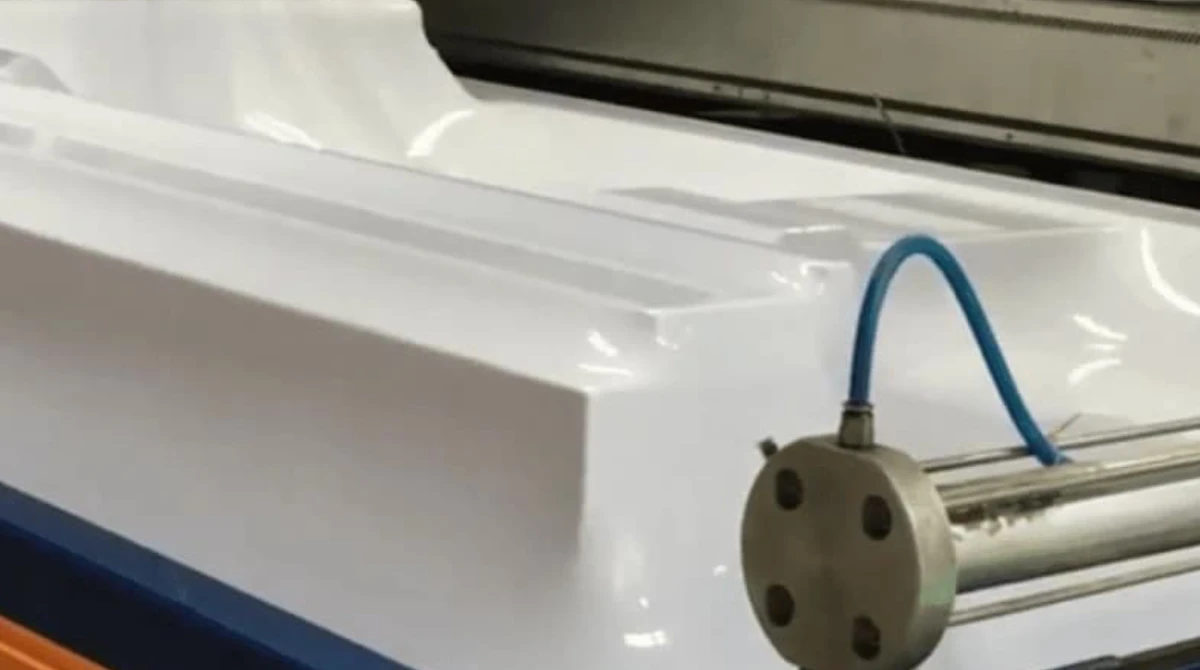
Incomplete Forming
Incomplete forming occurs when the thermoplastic sheet loses enough heat before or during vacuum draw to exit its elasto-plastic range — the temperature window in which it remains sufficiently fluid to conform fully to the mold under atmospheric pressure. Unlike poor detail reproduction, which manifests as shallow texture or rounded edges, incomplete forming is a more severe version of the same mechanism: the sheet stiffens before it has made full contact with the mold surface, leaving entire zones unbridged, corners unfilled, or deep draws arrested partway through. The result is a part that does not match the mold profile and cannot be salvaged by trimming or secondary operations.
Cooling rate is the critical variable. A cold mold extracts heat from the sheet contact surface within the first 1–2 seconds of touch, freezing the outer skin before vacuum draw is complete. Vacuum system leaks compound this by slowing air evacuation — every additional second of evacuation time is a second during which the sheet is cooling against the mold. Insufficient vacuum pump capacity relative to mold cavity volume produces the same effect: the pressure differential builds too slowly to draw the sheet before it stiffens. Mechanical forming aids — pre-stretch boxes, plug assists, and drape frames — that are at ambient temperature create localised cold spots at contact points, initiating premature stiffening in exactly the zones that require the most material flow.
This defect shares its root mechanism with poor detail reproduction — incomplete forming is the more severe end of the same spectrum, where cooling outpaces vacuum draw entirely rather than just limiting surface definition.
- Pre-heat the mold to 40–70°C before production. A thermally conditioned mold dramatically slows the rate of heat extraction from the sheet at first contact, extending the forming window by several seconds. Use embedded cartridge heaters, circulating hot water channels, or external pre-heating with a heat gun on smaller tooling. Allow the mold to stabilise at setpoint temperature for 20–30 minutes before the first production cycle — surface temperature measurement with a contact thermometer confirms readiness.
- Pre-heat all mechanical forming aids. Plug assists, pre-stretch boxes, and drape frames at ambient temperature act as heat sinks at the worst possible moment — during active material flow. Heat plugs to 50–80°C using embedded heaters or by pre-conditioning in an oven. Felt-wrapped plugs retain heat better than bare aluminium and distribute contact force more evenly, reducing localised stiffening at plug contact zones.
- Install a vacuum receiver to maximise evacuation speed. A pre-charged receiver tank releases the full pressure differential instantaneously when the forming valve opens, drawing the sheet into full mold contact in under 0.5 seconds. This is the single most effective hardware upgrade for incomplete forming caused by slow evacuation — it decouples peak airflow demand from pump continuous output and eliminates the gradual pressure build-up that allows the sheet to cool before draw is complete.
- Audit the vacuum system for leaks. A leaking clamp frame seal, cracked vacuum line, or worn valve seat continuously bleeds pressure and reduces the effective differential available at the mold. Perform a leak-down test: close the forming valve with the system at full vacuum and monitor pressure hold over 30 seconds. Any measurable pressure rise indicates a leak that must be located and sealed before process optimisation will be effective.
- Increase sheet forming temperature. If mold conditioning and vacuum system improvements do not fully resolve the defect, raise the sheet temperature to increase the available forming window. Extend oven dwell time in 5-second increments or raise heater output by 5°C steps. Verify actual sheet surface temperature with a contact pyrometer — do not rely on controller setpoints alone, as calibration drift of 15–30°C is common on older machines.
- Increase vent hole density in deep-draw and corner zones. Areas that form last — deep corners, undercuts, narrow channels — are most vulnerable to incomplete forming because they require the greatest material flow and are furthest from the initial vacuum draw point. Adding 0.8–1.0 mm vent holes concentrated in these zones reduces the residual air cushion that resists final sheet seating and accelerates local evacuation at the most critical geometry.
THERMOFORA Vacuum Forming Machines
Industrial vacuum forming machines — manufactured and ready to ship
From compact prototyping formats to full industrial sheet sizes. Every machine is built, tested, and shipped from our facility. Running in production across 24 countries.