
Vacuum forming machine price comes down to three shop-floor numbers: forming area, heater power, and automation level. A desktop 450×450 mm unit starts at $5,000. A large-format 3000×2000 mm machine runs above $90,000. Sheet size, draw depth, heater output, and process control decide the quote. This breakdown covers the full THERMOFORA vacuum forming machines range and a fully automatic vacuum forming machine for continuous production.
| Machine Type | Price Range | THERMOFORA Models |
|---|---|---|
| Desktop Vacuum Formers | from $5,000 | SMARTFORM 450 |
| Small Industrial Machines | from $11,000 | LITE 686 |
| Medium Industrial Machines | $16,000–$33,000 | LITE 1366, LITE 1010, LITE 1510, LITE 2010 |
| Large Format Machines | $65,000–$93,000+ | LITE 2215, LITE 2515, LITE 3020 |
| Heavy-Gauge Automatic Systems | from $85,000 | VORION |
| Roll-Fed Systems | from $48,000 | RAUT PRO |
Quick Answer: Industrial vacuum forming machine price usually runs between $16,000 and $93,000 depending on forming area, heating power, and drive system. Desktop and small-format machines typically start from $5,000. Fully automatic heavy-gauge systems for sheet plastic up to 12 mm start from $85,000 and scale by forming size, installed power, automation package, and material handling.
What drives vacuum forming machine price
Machine price follows the hardware. Bigger frames need more steel, larger heaters, stronger clamping, and more electrical capacity. Once you know which part drives the cost, it becomes easier to decide where to spend.
Forming area
Forming area is usually the biggest lever. A 450×450 mm machine runs 5 kW and starts at $5,000. Move up to 3000×2000 mm and the heater load reaches 380 kW, with a frame built for much higher sheet weight and clamping force. Start with the largest part you need to form. The rest of the specification follows from that.
Heating power and zone count
Infrared quartz heaters do the real work before vacuum ever touches the sheet. On a compact machine, one heating zone may be enough. On a large asymmetric part, it usually is not. A LITE 2215 can be configured with up to 176 independent zones, so the operator can reduce heat over shallow areas and push more energy into deep draw zones. That control reduces scrap, but every zone adds wiring, relays, and cost.
Drive systems
Heating carriage and forming table movement can be manual, pneumatic, or servo-driven. Manual movement is fine for prototyping and short runs. Pneumatics shorten the cycle and reduce operator effort. Servo drive costs more, but it gives repeatable positioning from one cycle to the next, which matters once the same mold runs all day.
Automation level
Base machines still need an operator for sheet loading, heating, and demolding. Semi-automatic modes remove some of that handling. A roll-fed machine like the RAUT PRO removes sheet loading completely for thin-gauge packaging work. The price increase is not just for convenience; it buys throughput.
Options and upgrades
Recipe saving, plastic pre-stretching, radiation pyrometer, air cooling, smart vacuum, and mold ventilation all solve specific process problems. The base frame sets the floor price. Options move the final quote depending on the defects you are trying to avoid.
Small vacuum forming machines: SMARTFORM 450 and LITE 686

These two machines sit at the small end of the range, but serve different workshops. SMARTFORM 450 runs from single-phase power. LITE 686 needs three-phase power, but gives more sheet area, depth, and faster table movement.
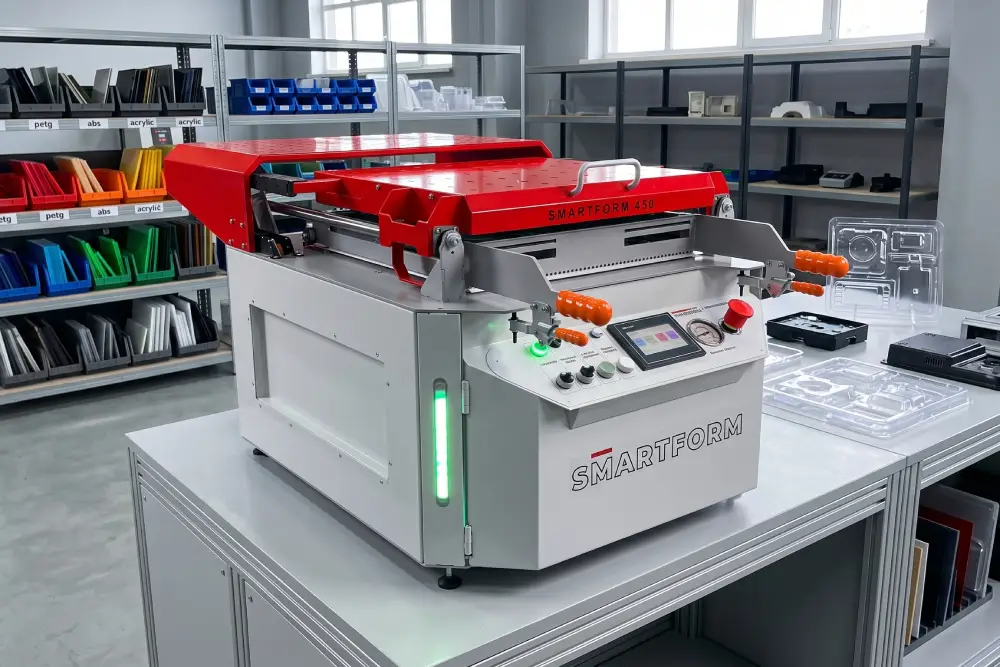
SMARTFORM 450 desktop vacuum forming machine, from $5,000
SMARTFORM 450 is the lowest-cost professional machine in the lineup. Single-phase 220V keeps installation simple, so it can work in a studio, lab, or small workshop without a dedicated industrial power line. The 450×450 mm forming area and 200 mm draw depth cover prototypes, small packaging inserts, architectural models, and training work. All three drives are manual. That keeps the price down and leaves very little to maintain.
| Parameter | Value |
|---|---|
| Sheet size | 500 × 500 mm |
| Forming area | 450 × 450 mm |
| Max depth of draw | 200 mm |
| Max material thickness | 6 mm |
| Power supply | Single phase / 220 V |
| Power consumption | 5 kW |
| Heaters | Infrared quartz, 250 W each |
| Heating drive | Manual |
| Table drive | Manual |
| Control | 4.3" operator panel |
| Price | from $5,000 USD |
| Page | SMARTFORM 450 details |
Typical use: prototypes, design labs, training, mockups, cosplay parts.
LITE 686 floor-standing vacuum forming machine, from $11,000
LITE 686 is where small-batch production starts to make sense. The forming area increases to 646×620 mm, draw depth reaches 300 mm, and the machine uses 17 kW on three-phase 400V power. In practice, that gives steadier heat across a larger sheet and enough power for materials up to 6 mm. The pneumatic table drive also removes one slow manual step from each cycle.
| Parameter | Value |
|---|---|
| Sheet size | 686 × 660 mm |
| Forming area | 646 × 620 mm |
| Max depth of draw | 300 mm |
| Max material thickness | 6 mm |
| Power | 17 kW / 3~ 400 V / 50 Hz |
| Heaters | Infrared quartz, 450 W each |
| Heating drive | Manual |
| Table drive | Pneumatic |
| Control | 4.3" operator panel |
| Price | from $11,000 USD |
| Page | LITE 686 details |
Typical use: blister packs, trays, signage, POS displays, enclosures, containers, and medical trays.
Medium format machines: LITE 1366, LITE 1010, LITE 1510, LITE 2010
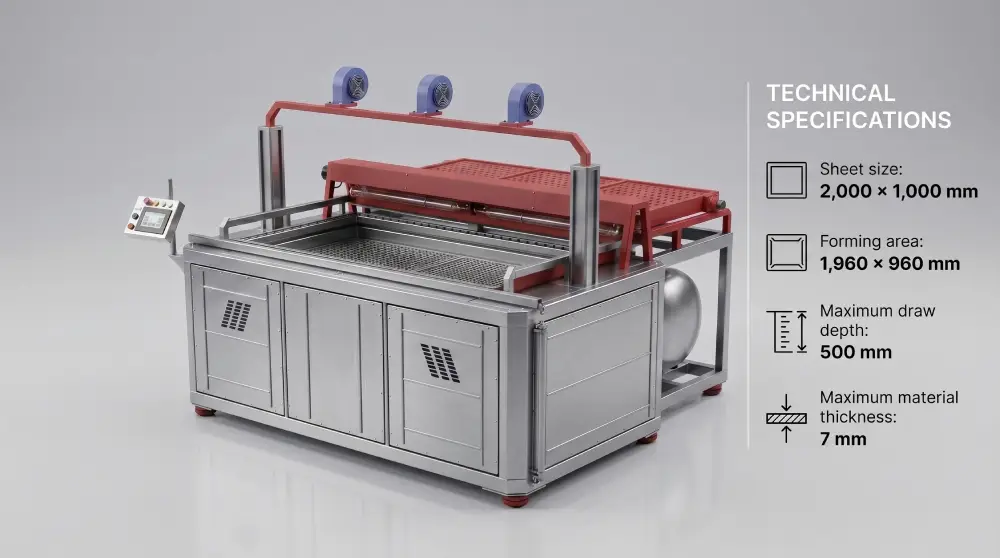
Most production shops end up in this range. Forming areas run from roughly 1300×600 mm to 1960×960 mm. Larger models use servo-driven heating, and heating-zone options go up to 100 zones. Power ranges from 28 kW to 125 kW.
LITE 1366: from $16,000
LITE 1366 is built for parts that are wide but not tall. The 1332×620 mm forming area is almost double the width of the LITE 686 while keeping the same 660 mm sheet depth. That format works well for signage panels, automotive trim strips, and wide shallow packaging. At 28 kW, it handles medium-gauge ABS, PETG, and PVC in normal production settings. Available on request; contact us for lead time.
| Parameter | Value |
|---|---|
| Sheet size | 1,366 × 660 mm |
| Forming area | 1,332 × 620 mm |
| Max depth of draw | 350 mm |
| Max material thickness | 6 mm |
| Power | 28 kW / 3~ 400 V / 50 Hz |
| Price | from $16,000 USD |
| Heating drive | Manual |
| Availability | On request |
Typical use: long signage panels, automotive trim strips, elongated packaging formats, and POS display components. The value here is width.
LITE 1010: from $18,000
LITE 1010 is the square-format machine in the lineup. The 960×960 mm forming area, 400 mm draw depth, and servo-driven heating suit square or near-square parts that waste too much sheet on a long rectangular machine. The 7 mm material limit also opens the door to structural ABS and engineering-grade polycarbonate. Available on request; contact us for availability.
| Parameter | Value |
|---|---|
| Sheet size | 1,000 × 1,000 mm |
| Forming area | 960 × 960 mm |
| Max depth of draw | 400 mm |
| Max material thickness | 7 mm |
| Power | 65 kW / 3~ 400 V / 50 Hz |
| Heating drive | Servo |
| Table drive | Pneumatic |
| Price | from $18,000 USD |
| Availability | On request |
Typical use: bath panels, agricultural seed trays, technical enclosures, and deep square packaging where a rectangular machine would waste too much sheet.
LITE 1510 industrial vacuum forming machine, from $25,000
LITE 1510 is one of the models we see used most often in production. The 1460×960 mm forming area covers many industrial parts without pushing the buyer into a large-format frame. The 86 kW servo-driven heating system is built for repeated cycles, and up to 77 heating zones can be added for asymmetric parts.
| Parameter | Value |
|---|---|
| Sheet size | 1,500 × 1,000 mm |
| Forming area | 1,460 × 960 mm |
| Max depth of draw | 400 mm |
| Max material thickness | 7 mm |
| Power | 86 kW / 3~ 400 V / 50 Hz |
| Heating drive | Servo |
| Table drive | Pneumatic |
| Control | 7" operator panel |
| Heating zones (option) | Up to 77 |
| Price | from $25,000 USD |
| Page | LITE 1510 details |
Typical use: automotive interior panels, bumper liners, electronics packaging, medical packaging, agricultural equipment covers, advertising display structures, and HVAC enclosures. For many workshops, this is the first truly flexible industrial format.
LITE 2010: from $33,000
LITE 2010 extends the forming area to 1960×960 mm and increases draw depth to 500 mm. That puts it in range for deep automotive parts, boat hull sections, vehicle body panels, and larger agricultural covers. At 125 kW, the heater system is a clear step above the LITE 1510. Pneumatic clamping on both axes becomes standard at this sheet size.
| Parameter | Value |
|---|---|
| Sheet size | 2,000 × 1,000 mm |
| Forming area | 1,960 × 960 mm |
| Max depth of draw | 500 mm |
| Max material thickness | 7 mm |
| Power | 125 kW / 3~ 400 V / 50 Hz |
| Heating drive | Servo |
| Table drive | Pneumatic |
| Clamping frame | Pneumatic |
| Heating zones (option) | Up to 100 |
| Price | from $33,000 USD |
| Page | LITE 2010 details |
Typical use: automotive panels, boat components, agricultural covers, and construction cladding.
Large format machines: LITE 2215, LITE 2515, LITE 3020

Large-format machines are built for oversized industrial parts: automotive body panels, boat hull sections, architectural cladding, agricultural equipment covers, and refrigerator liners. Forming areas run from 2160×1460 mm up to 3000×2000 mm. Power runs from 210 kW to 380 kW. All three models use servo-driven heating carriages with pneumatic tables and clamping frames.
LITE 2215: from $65,000
LITE 2215 is the large-format model we see requested most often. The 2160×1460 mm forming area and 500 mm draw depth cover many automotive and industrial parts. Up to 176 independent heating zones can be configured. At this size, zone control is usually needed unless the part is flat and uniform.
| Parameter | Value |
|---|---|
| Sheet size | 2,200 × 1,500 mm |
| Forming area | 2,160 × 1,460 mm |
| Max depth of draw | 500 mm |
| Max material thickness | 7 mm |
| Power | 210 kW / 3~ 400 V / 50 Hz |
| Heating drive | Servo |
| Table drive | Pneumatic |
| Clamping frame | Pneumatic |
| Heating zones (option) | Up to 176 |
| Price | from $65,000 USD |
| Page | LITE 2215 details |
Typical use: automotive exterior and interior panels, boat and watercraft components, agricultural cab covers, large advertising structures, architectural cladding, refrigerator liners, and medical imaging housings. This format is for parts where sheet handling affects process planning.
LITE 2515: from $72,000
LITE 2515 adds 300 mm of forming width over the LITE 2215 and raises heater power to 240 kW. That extra width matters when parts sit near the 2215 limit, but a full 3-meter machine is too large. Contact us for lead time.
| Parameter | Value |
|---|---|
| Sheet size | 2,540 × 1,540 mm |
| Forming area | 2,500 × 1,500 mm |
| Max depth of draw | 500 mm |
| Max material thickness | 7 mm |
| Power | 240 kW / 3~ 400 V / 50 Hz |
| Heating drive | Servo |
| Price | from $72,000 USD |
Typical use: the same work as LITE 2215, but for parts that keep landing near the 2200 mm width limit. The extra width helps with tight nesting and trimming.
LITE 3020: from $93,000
LITE 3020 is the largest machine in the lineup: 3 meters of forming length, 2 meters of width, and 380 kW of installed power. This is infrastructure-level equipment. It needs dedicated electrical service and floor space planned around the machine. The parts usually cannot be made on anything smaller: full vehicle roof liners, large boat hull sections, swimming pool shells, and industrial covers over 2.5 meters. Contact us for a specific quote.
| Parameter | Value |
|---|---|
| Sheet size | 3,040 × 2,040 mm |
| Forming area | 3,000 × 2,000 mm |
| Max depth of draw | 500 mm |
| Max material thickness | 7 mm |
| Power | 380 kW / 3~ 400 V / 50 Hz |
| Heating drive | Servo |
| Price | from $93,000 USD |
Typical use: vehicle roof liners, swimming pool shells, boat hull sections, and large industrial enclosures. At this size, the machine is usually bought around one or two large product families, not general workshop flexibility.
VORION automatic heavy-gauge vacuum forming machine, from $85,000
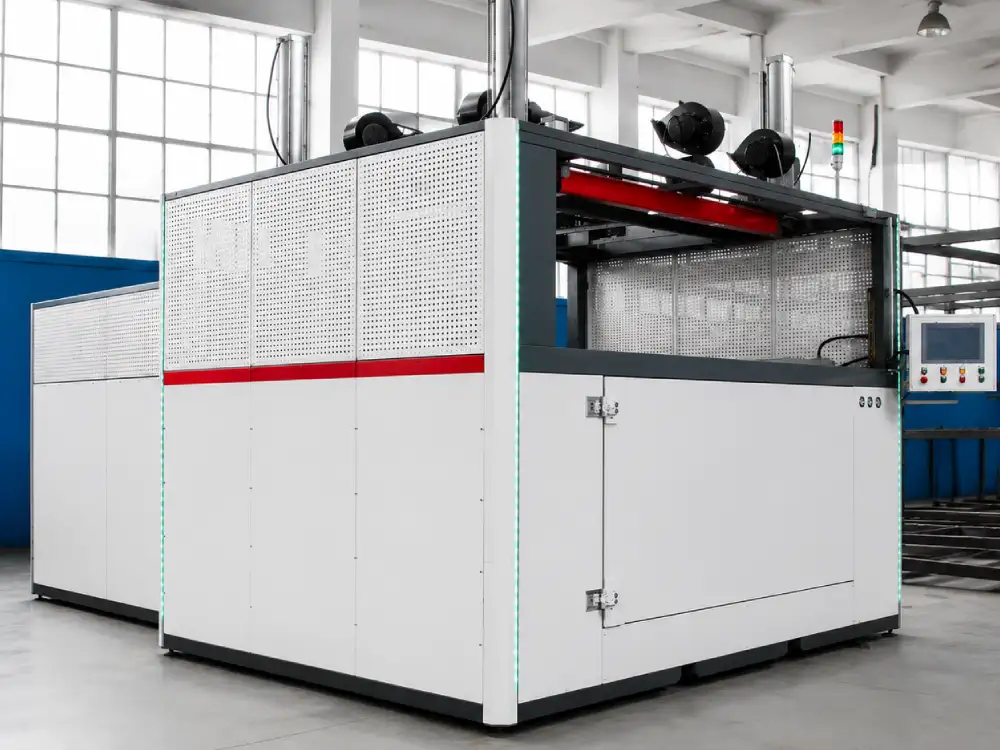
VORION is the fully automatic heavy-gauge line in the THERMOFORA range. It is built for industrial sheet thermoforming where the part is too large, too thick, or too repetitive for a manually operated LITE machine. The model range covers forming areas from 1000 × 1000 mm to 6000 × 2200 mm, with forming depth up to 1000 mm and sheet thickness up to 12 mm. The starting vacuum forming machine price is $85,000, and the final price depends on machine size, installed power, material handling, pressure forming, cooling, and other factory-installed options.
| Parameter | Value |
|---|---|
| Model range | VORION 1010, 2010, 2515, 3020, 4020, 6022 |
| Forming area | 1000 × 1000 to 6000 × 2200 mm |
| Max forming depth | 500–1000 mm, depending on model |
| Max material thickness | Up to 12 mm |
| Power supply | 3~ 400 V / 50 Hz |
| Installed power | 57–600 kW |
| Heating system | Quartz or halogen infrared heating elements |
| Control system | Industrial PLC with HMI touchscreen |
| Drive systems | Servo-driven heating, forming table, and clamping frame |
| Materials | ABS, PET, PETG, HIPS, PS, PVC, PP, PE, PC, PMMA |
| Options | 40+ factory-installed options, including automatic sheet loading, reduction plates, pressure forming, cooling systems, and advanced automation |
| Price | from $85,000 USD |
| Page | VORION details |
Typical use: automotive and aerospace panels, sanitary products, refrigeration liners, logistics pallets, protective covers, large technical housings, and other heavy-gauge parts where repeatability, servo motion, and automated handling matter more than the lowest machine price.
RAUT PRO roll-fed automatic vacuum forming machine, from $48,000

RAUT PRO belongs to a different category. The LITE series runs sheet-fed cycles; RAUT PRO processes plastic film from a roll. Sheet loading is automatic, so the main manual bottleneck disappears. The forming area is 350×350 mm with 200 mm depth, which makes it a thin-gauge packaging machine rather than a structural part machine. At $48,000, the automatic vacuum forming machine price is higher than several larger LITE models because the cost sits in continuous feed, indexing, film tensioning, and scrap handling. For buyers comparing roll-fed thermoforming machine price, that automation is the number that matters.
| Parameter | Value |
|---|---|
| Forming area | 350 × 350 mm |
| Max depth of draw | 200 mm |
| Power consumption | 10 kW |
| Feed type | Roll-fed, automatic |
| Price | from $48,000 USD |
Typical use: blister packaging, food trays, medical packaging, and high-volume thin-film PET, PVC, or HIPS work. RAUT PRO makes sense when manual sheet loading is the bottleneck, not when the part needs a larger forming area.
Full Vacuum Forming Machine Price and Thermoforming Machine Price Comparison
| Model | Forming Area | Max Depth | Max Thickness | Power | Price (from) |
|---|---|---|---|---|---|
| SMARTFORM 450 | 450 × 450 mm | 200 mm | 6 mm | 5 kW | $5,000 |
| LITE 686 | 646 × 620 mm | 300 mm | 6 mm | 17 kW | $11,000 |
| LITE 1366 | 1,332 × 620 mm | 350 mm | 6 mm | 28 kW | $16,000 |
| LITE 1010 | 960 × 960 mm | 400 mm | 7 mm | 65 kW | $18,000 |
| LITE 1510 | 1,460 × 960 mm | 400 mm | 7 mm | 86 kW | $25,000 |
| LITE 2010 | 1,960 × 960 mm | 500 mm | 7 mm | 125 kW | $33,000 |
| LITE 2215 | 2,160 × 1,460 mm | 500 mm | 7 mm | 210 kW | $65,000 |
| LITE 2515 | 2,500 × 1,500 mm | 500 mm | 7 mm | 240 kW | $72,000 |
| LITE 3020 | 3,000 × 2,000 mm | 500 mm | 7 mm | 380 kW | $93,000 |
| VORION | 1000 × 1000 to 6000 × 2200 mm | 500–1000 mm | Up to 12 mm | 57–600 kW | $85,000 |
| RAUT PRO | 350 × 350 mm (roll-fed) | 200 mm | 3 mm film | 10 kW | $48,000 |
What Does a Vacuum Forming Machine Really Cost to Run?
For budgeting, treat thermoforming equipment cost as the machine price plus installation, first tooling, sheet trials, and operator setup. The quote gets the machine into your building; the extra items get it into production.
The vacuum forming machine price is the largest single line item, but it is not the whole budget. A production setup also needs electrical work, ventilation, tooling, trial material, and sometimes commissioning.
Electrical installation. Every machine above 5 kW requires a dedicated three-phase 400V supply. If your facility already has three-phase service at the right amperage, connection cost is minimal. If not, budget $500–2,000 for electrical work depending on distance from the distribution panel and local rates.
Local exhaust ventilation. Forming ABS, PC, PVC, and acrylic releases VOCs. A basic overhead extraction system starts at $300–1,500. Skipping it is an occupational health violation and will eventually contaminate your mold surfaces.
First tooling. The machine can be ready on day one. The mold usually is not. For prototyping and low-volume work, MDF tooling is the simplest starting point. A well-made MDF mold for a mid-size part costs $500–1,500 and can run hundreds of cycles before wear becomes a problem. Aluminum tooling costs more and usually comes later, once the part is proven.
Sheet stock. Typically purchased per job. Budget for initial material trials when qualifying a new machine or mold: expect 5–10 trial sheets before parameters are dialed in.
Training and commissioning. If you need operator training or commissioning support, discuss it before purchase. Training and commissioning can reach up to 5% of the machine price depending on scope, travel, and duration. Plan this before delivery.
| Cost Item | Typical Range |
|---|---|
| Electrical connection | $500–2,000 |
| Exhaust ventilation | $300–1,500 |
| First MDF mold | $500–1,500 |
| Material trials (10 sheets) | $100–400 |
| Training and commissioning | Up to 5% of machine price |
| Total additional | $1,400–6,400 + commissioning |
The machine price is paid once. Over 5 years, sheet material and energy usually dominate total cost of ownership. That is why every spec table on this page includes installed power.
Used vacuum forming machine price
Used vacuum forming machine price often looks attractive on the first quote. Before comparing it with a new machine, check the control system, heater condition, vacuum pump wear, and spare parts availability. On the shop floor, a used machine becomes expensive when one failed heater bank or unsupported PLC stops production for a week. If the seller cannot show recent forming cycles, wiring documentation, and spare parts sources, treat the discount as risk rather than savings.
THERMOFORA vs Chinese Vacuum Forming Machines: What the Price Difference Buys
Search for "vacuum forming machine price" and you will find Chinese machines listed at $3,000–8,000 for forming areas that look comparable to LITE 686 or LITE 1510. The price gap is real. The difference is in the parts of the machine that control heat, vacuum, clamping, and support after delivery.
Heater wavelength and material compatibility. Budget Chinese machines typically use short-wave heaters below 1 micron. They heat the surface fast, but the heat does not move uniformly through the sheet. Transparent polycarbonate and other demanding materials suffer first. Medium-wave quartz heaters in the 2.4–4.0 µm range match the absorption range of most engineering thermoplastics and are standard across the LITE series.
Heating control. Heater output is managed through PLC-controlled power regulation across independent zones. The operator sets each zone from the interface, and the zone layout is matched to the forming area. That gives a more even sheet temperature, especially on large asymmetric parts and materials with narrow forming windows. Budget machines often have no zone-level control.
Vacuum management. Vacuum timing, rate, and duration can be saved per recipe. This matters when a material needs a slow first draw to avoid webbing, or when a deep part thins out under a hard vacuum surge. Budget machines usually apply full vacuum in one fixed step.
Clamping frame. Adjustable clamping pressure lets the operator change sheet thickness without modifications or shim plates. Fixed-force clamping can work on one material and leak on the next. That leak often shows up as uneven draw near the edge of the part.
After-sales support. THERMOFORA machines run in 24 countries, with a documented spare parts supply chain. With budget marketplace machines, spare parts availability often becomes unclear after 18–24 months.
Common buying mistakes that change the real machine cost
The cheapest quote is not always the lowest-cost machine. Most expensive mistakes happen before the machine is ordered, when the buyer compares only forming area and base price.
| Mistake | What happens in production | Better check |
|---|---|---|
| Buying by sheet size only | The part fits the sheet, but not the usable forming area after clamp allowance. | Measure finished part size, flange, trim margin, and draw depth before choosing the model. |
| Ignoring electrical capacity | The machine arrives before the facility can power it, delaying commissioning. | Confirm three-phase supply, available amperage, cable run, and breaker capacity before purchase. |
| Underestimating first tooling | The machine is installed, but production waits on molds or runs poor MDF tooling. | Budget the first mold and 5–10 trial sheets with the machine, not after it. |
| Buying used without checking controls | A cheap machine becomes expensive when the PLC, heater relays, or vacuum pump cannot be supported. | Ask for recent forming videos, wiring documentation, spare parts sources, and controller model numbers. |
| Skipping heating-zone options on complex parts | Large or asymmetric parts come out with thin corners, webbing, or uneven gloss. | Match zone control to part geometry, not only to machine size. |
What to Consider Before Buying a Vacuum Forming Machine
Most buyers start with budget and try to fit a machine into it. That is usually backwards. Start with the part: outside dimensions, flange allowance, draw depth, material thickness, and monthly volume. Then the machine size becomes much clearer.
Step 1: Measure your largest part
The forming area has to be larger than the part, including flange allowance. Add 50–80 mm on each side for clamping frame grip. A part that measures 900×700 mm needs at least a 1000×800 mm forming area, which usually points to LITE 1010 or LITE 1510 depending on shape and depth.
Step 2: Check draw depth
Shallow parts under 150 mm can be formed on any machine in the range. Parts with draw depth above 300 mm need machines from the LITE 1010 upward, which have 400–500 mm capacity and support the pre-stretch option to prevent excessive wall thinning on deep draws.
Step 3: Assess material thickness
Thin-gauge packaging (0.2–0.8 mm PET and PVC) can run on any machine or on the RAUT PRO for high volume. Structural parts in ABS or PC at 4–7 mm need the heating power and structural rigidity of the LITE 1010 and above. Heating thick material with an undersized heater produces surface scorching before the core temperature reaches forming range.
Step 4: Estimate volume
For low volume under 500 parts/month, SMARTFORM 450 or LITE 686 with manual heating drive is usually enough. At 500–5,000 parts/month, servo heating becomes more useful because repeatability starts to matter. High-volume thin-film packaging points to RAUT PRO. Large structural parts in higher volume usually start with LITE 2010 and semi-automatic operation.
Step 5: Factor in the options that matter for your process
Recipe saving becomes useful as soon as you run more than one material or mold. Pre-stretching matters on deep draws above a 2:1 draw ratio. Zone control matters when one area of the part is shallow and another is deep. A radiation pyrometer can bring cycle-to-cycle temperature variation from 10–15°C down to 3–5°C. Choose options around the defect you are trying to prevent, not around a feature list.
For a detailed breakdown of how to evaluate forming area, heating systems, and automation level, see how to buy a vacuum forming machine.
FAQ
What else do I need to buy besides the vacuum forming machine?
The machine itself is the main cost, but a production setup needs a few additional items. Electrical connection: every machine above 5 kW needs dedicated three-phase 400V supply, usually $500–2,000 depending on the facility. Local exhaust ventilation: ABS, PC, and PVC forming need extraction; a basic system costs $300–1,500. First mold: MDF tooling for a mid-size part runs $500–1,500 and is the right starting point for most buyers. Plastic sheet stock is usually purchased per run, but budget for 5–10 trial sheets when qualifying a new setup. Training and commissioning can reach up to 5% of the machine price if on-site support is needed.
How much does a vacuum forming machine cost?
Vacuum forming machine prices range from $5,000 for a desktop unit (450×450 mm, 5 kW) to $93,000 and above for large-format industrial machines (3000×2000 mm, 380 kW). Mid-range production machines in the 1000–2000 mm forming area range run $18,000–$65,000 depending on power output and automation level. Vacuum former price is lower on small manual units and rises quickly once servo heating, pneumatic clamping, and multi-zone control are added. As a capital investment, the machine typically pays back within 12–24 months at medium production volumes.
What is the cheapest vacuum forming machine for production use?
The LITE 686 starts at $11,000 and is the lowest-cost machine suited for sustained production work. The SMARTFORM 450 starts at $5,000 but is better suited to prototyping and low-volume applications rather than continuous production runs.
Why is a roll-fed vacuum forming machine more expensive than a larger sheet-fed machine?
The RAUT PRO costs $48,000 despite its 350×350 mm forming area because the price is in the automation system, not the forming size. Roll-fed machines remove manual sheet loading and unloading, which is the main bottleneck in high-volume thin-gauge packaging. Continuous feed, film tensioning, indexing, and scrap winding add significant cost compared with a sheet-fed unit.
How do heating zones affect vacuum forming machine price?
Independent heating zones are an option on all LITE series machines. More zones mean more precise temperature control across different areas of the sheet: important for asymmetric parts, deep draws, or materials with uneven thickness. Zone control adds cost because each zone requires its own controller, wiring, and heater relay. The LITE 2215 can be configured with up to 176 zones. For simple flat or shallow parts, fewer zones are sufficient.
Which vacuum forming machine is best for automotive parts?
For most automotive interior and exterior components, the practical range is LITE 1510, LITE 2010, and LITE 2215. Interior trim pieces and instrument panel inserts typically fit within the LITE 1510's 1460×960 mm forming area. Full door panels and exterior body components often require LITE 2010 or LITE 2215. For structural automotive parts, servo-driven heating, multi-zone control, and pre-stretching matter more than raw forming area alone.
Is a used vacuum forming machine worth it?
A used vacuum forming machine can be worth it if the machine is still supported, the heaters are in good condition, and the seller can show recent forming cycles. The price usually looks better than a new machine, but the risk sits in the parts you cannot see from a photo: PLC, heater relays, vacuum pump, wiring, seals, and spare parts availability. Before buying used, ask for wiring documentation, controller model numbers, spare parts sources, and a video of the machine forming an actual part. For simple low-volume work, used can make sense. For production where downtime costs money, a new machine is usually the safer buy.
Why do industrial vacuum forming machines cost more than desktop vacuum formers?
Industrial vacuum forming machines cost more because they have to heat, clamp, and move a much larger sheet with repeatable control. A desktop vacuum former may run on 5 kW and single-phase power. An industrial machine can use 65–380 kW, three-phase power, pneumatic clamping, servo-driven heating, and dozens or hundreds of heating zones. The price difference is not just size. It is process control: stronger frames, more stable heaters, better vacuum management, and controls that can repeat the same cycle all day.
Can I buy drawings to build a vacuum forming machine myself?
In addition to complete ready-made machines, full documentation packages are available for manufacturers who prefer to build in-house. The package includes 3D CAD assembly files in SolidWorks and STEP format, DXF and PDF files for laser cutting and sheet metal bending, complete electrical schematic, pneumatic and vacuum circuit diagram, PLC program for Delta controller, and HMI operator panel program. This is an alternative to purchasing a ready-made machine, not something that comes with it.
For the forming process from heating to demolding, see Vacuum Forming Basics: How the Process Actually Works. For material selection data, including forming temperatures, shrinkage rates, and drying requirements, see Thermoforming Plastics: ABS, PETG, PP, PC, HDPE, HIPS.
THERMOFORA Vacuum Forming Machines
Industrial vacuum forming machines, manufactured and ready to ship
From compact prototyping formats to full industrial sheet sizes. Built, tested, and shipped from our facility. Running in 24 countries.