
THERMOFORA · Updated 2026 · 28 min read
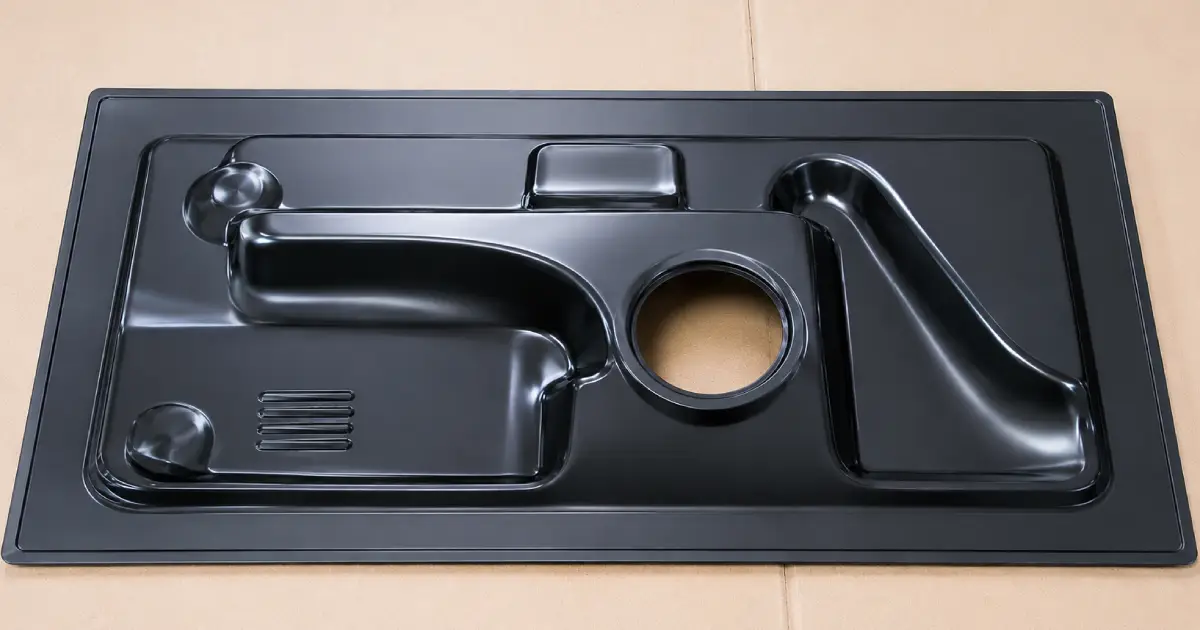
Vacuum formed products show up everywhere once you start looking: the liner inside a truck bed, the housing on a medical cart, the shell of a hot tub, the dunnage tray that carries a transmission down an assembly line, the raised letters on a storefront sign. All of them are made the same basic way, typically on an automatic vacuum forming machine: a plastic sheet is heated until it sags, pulled down onto a mold with vacuum, and cooled into a rigid shape. What separates a good custom vacuum formed part from a bad one isn't the concept, it's the combination of sheet gauge, material, mold design, and machine setup behind it. This article walks through the main categories of vacuum formed plastic products, the materials we run for each, what happens on the floor when a custom thermoformed part goes from drawing to finished piece, the secondary operations that turn a raw shell into a usable component, and how to think about sourcing vacuum forming services for your own project.
What counts as a vacuum formed product
"Vacuum formed" covers a wider range of products than most people expect. The dividing line that matters most is sheet thickness: thin-gauge work under ~1.5 mm covers blister packs and disposable trays, run on high-speed roll-fed machines. Heavy-gauge starts around 1.5 mm and goes past 12 mm — this is where THERMOFORA machines operate: structural panels, equipment housings, vehicle components, and large-format covers built to survive years of use. A shop set up for thin-gauge blister packs can't run a 4 mm ABS dashboard; the heaters, clamping frame, vacuum capacity, and cycle time are sized for a completely different job.
There's also a middle ground worth naming: pressure forming adds positive air pressure — typically 2–6 bar — to the back of the sheet while vacuum pulls from the mold side. The extra pressure pushes the sheet into fine detail that vacuum alone can't reach: sharp corners, embossed logos, vents, and texture. Most cosmetic retail and signage work benefits from at least some pressure assist, even on machines built primarily as vacuum formers.
Categories of vacuum formed plastic products
Automotive and transportation
This is one of the most consistent sources of heavy-gauge work. Vehicles need large, lightweight, impact-resistant panels that would be prohibitively expensive to injection mold at low-to-mid volumes. Most automotive vacuum formed products run 3–6 mm starting sheet.
- Trunk tubs and cargo liners are deep-drawn HDPE or ABS forms that protect the load floor. Draw depth routinely exceeds a 1:1 ratio on this geometry, so plug assist is standard rather than optional.
- Truck bed liners: heavy wall sections running 4–6 mm starting gauge in HDPE to absorb repeated impact without cracking. Ribbed patterns built into the tool add stiffness without a separate reinforcing part.
- Dashboards and instrument panels call for textured ABS or ABS/PMMA on the visible face. UV stability is the primary material driver, and every 0.025 mm of texture depth adds directly to the draft angle the mold needs.
- Bumpers, spoilers, and wheel arch extensions are large single-sheet panels with moderate draw depth, typically trimmed to profile and bonded to a structural backer before assembly.
- RV interior and exterior panels cover wall liners, wheel well covers, and ceiling panels in textured ABS. These often run as matched left/right pairs from a single mirrored tool to keep cost down on low-volume coach builds.
- Marine dashboards and engine hatch covers use UV-stable acrylic-capped sheet to handle salt and sun exposure. Fastener bosses go on as a secondary bonding step since the cap layer doesn't accept insert geometry cleanly during forming.
Industrial and agricultural equipment
Heavy machinery builders use vacuum forming for body panels and guards that would be too costly to tool for steel stamping at their production volumes. A steel stamping die for a single tractor hood can cost more than an entire vacuum forming machine.
- Tractor hoods and body panels are among the largest single-piece jobs vacuum forming handles routinely. Large-format ABS or HDPE with ribbing added by bonding a formed backer is the standard approach, since the process can't mold ribs in directly the way injection molding can.
- Machine guards and protective covers: when visibility into the machine is needed while it's running, PETG or polycarbonate replaces ABS. Clear materials require extra attention to vent placement since any mark shows through the finished part.
- HVAC housings for rooftop and outdoor units are a natural fit for HDPE, which handles UV and weather exposure without needing an acrylic cap layer. Wall thickness typically runs 3–5 mm to survive installation and service access.
- Heavy-duty toolboxes and equipment cases are usually formed as two halves in HDPE or ABS with reinforced corners, then bolted or snapped together along a perimeter flange.
- Lawn and garden equipment covers — mower decks, rider housings, snowblower shrouds — run in PP for resistance to fuel and oil splash. Because PP crystallizes on cooling, mold temperature control matters more here than it does with ABS.
Mass transit and rail
Rail and bus interiors demand lightweight, easy-clean panels compliant with fire and smoke regulations — which rules out standard ABS without a flame-retardant additive.
- Railcar interior trim panels cover side walls, ceiling sections, and partition faces in flame-retardant ABS or FR-rated PETG. Panels often run 2–3 mm and span the full width of a car section, which puts demands on oven uniformity — any hot or cold zone reads directly as a thickness variation across the part.
- Seat shells and seat-back panels for trains and buses are formed as single-piece skins over a structural foam or metal frame. The formed shell handles the visible surface and impact resistance; the frame carries the load. Matched left/right pairs from a mirrored tool are common to keep tooling cost down on mid-volume coach contracts.
- Overhead luggage racks, window surrounds, and door header panels fill out the interior package. These parts are usually simpler geometry than seat shells, but the fit tolerances are tighter because they have to align with certified structural assemblies.
- Subway and tram driver cab fascias, instrument panel surrounds, and door edge protectors round out the category. Polycarbonate or PC/ABS blends appear here where impact resistance in a high-contact area matters more than cost.
Medical and healthcare equipment
Medical housings need smooth, seamless surfaces that survive repeated disinfectant wipe-downs. Seams are minimized because they trap contamination.
- Medical device housings and enclosures: PETG handles most common hospital disinfectants without hazing or crazing; PC is the step up for harsher chemistries.
- Imaging equipment covers benefit from single-sheet forming — a seamless one-piece shell is a functional requirement in clinical settings, not just an aesthetic preference.
- Hospital bed components (side rails, headboards, footboards) are formed with fully radiused edges as standard. Sharp corners fail patient-safety review and are difficult to clean thoroughly in a clinical setting.
- Medical cart shells and instrument trays often use PETG specifically for clarity — staff can identify tray contents at a glance without opening or moving the container, which matters in a fast-paced clinical workflow.
Electronics and industrial enclosures
Industrial control housings are a natural fit: straightforward geometry, low volumes where injection tooling cost is hard to justify, and customers focused on surface finish and dimensional repeatability.
- HMI and operator panel housings are typically formed in 3–4 mm ABS with a textured A-side. The bezel around the screen cutout is the critical dimension; the rest of the housing tolerances are more forgiving. CNC routing after forming handles the screen opening and mounting hole pattern.
- Server rack side panels and enclosure skins in data centres and industrial control rooms are often vacuum formed ABS or HIPS, finished in a consistent grey or black. The formed skin clips or screws to a welded steel frame that carries the structural load.
- Arcade and gaming cabinet panels were among the early heavy-gauge applications of vacuum forming and remain a steady category for shops with large-format machines. The curved front bezels, control panel surrounds, and side art panels on modern gaming equipment are almost always thermoformed rather than fabricated from flat sheet.
- Enclosures for outdoor electrical equipment — junction boxes, meter housings, distribution panel covers — use UV-stable HDPE or acrylic-capped ABS to handle sun and weather without chalking or cracking over a service life measured in years.
Retail displays and signage
Retail is where vacuum forming gets visually ambitious. Three-dimensional logos, raised lettering, and deep relief are impossible to produce as flat printed graphics, and pressure forming produces the crisp edges that retail clients expect on these parts.
- Point-of-purchase and point-of-sale displays are typically short-run work in PETG for clarity, refreshed seasonally as product campaigns change. Vacuum forming handles these volumes well where injection molding tooling cost would be difficult to justify.
- Dimensional sign faces need even wall thickness across the entire lit surface. Any thin spot reads as a hot spot under backlighting; any thick area goes comparatively dark. Pressure forming rather than vacuum-only is what makes even draw achievable on large sign faces.
- Lightbox housings call for translucent white or opal sheet so the light source diffuses rather than showing as a point. The seamless one-piece shell that vacuum forming produces is exactly what sign integrators want here.
- Cosmetic and product display inserts are usually high-clarity PETG so the product stays the visual focus. Draw depth is typically shallow on these parts, which means wall thickness stays relatively even without plug assist.
For more on this segment, see vacuum forming for signage production, which covers sheet selection and mold considerations for illuminated sign faces in more depth.
Kiosks and self-service equipment
The outer fascias of ATMs, payment terminals, self-checkout kiosks, and ticketing machines are a category where vacuum forming is well established but rarely discussed in the same breath as automotive or medical. The parts are large, the volumes are low-to-mid, and the finish requirements are close to retail — which is exactly the profile where vacuum forming with pressure assist makes economic sense.
- ATM and cash machine fascias are typically formed in 3–4 mm ABS with a painted or textured finish. The card slot surrounds, screen bezels, and keypad recesses are built into the mold geometry rather than added as separate parts, which keeps the assembly count low and the surface seamless.
- Self-checkout terminal housings run similarly — a formed outer shell in ABS or acrylic-capped ABS, bonded or fastened to a steel chassis. The shell handles the visible surface and protects the electronics from casual impact; the chassis carries the structural load.
- Information kiosk enclosures for transport hubs, retail environments, and outdoor installations often call for UV-stable acrylic-capped ABS or HDPE. Outdoor kiosks add a requirement for weather resistance that rules out standard interior-grade ABS without additional surface treatment.
- Vending machine front panels are large single-piece forms, often with backlit sections in translucent PETG or acrylic. The seamless one-piece construction that vacuum forming produces is what keeps the light from leaking at joints.
Packaging and material handling
- Custom dunnage trays hold tighter dimensional tolerances than most other vacuum formed parts because the pocket geometry has to seat a specific component the same way every time through thousands of handling cycles. Automotive and electronics supply chains are the primary users.
- Plastic pallets and heavy-duty bins in HDPE or PP are designed for repeated stacking and forklift handling. A waffle or rib pattern formed into the underside adds stiffness without adding wall thickness or material cost.
- ESD-safe trays use conductive or static-dissipative sheet to protect circuit boards and electronic components in transit. The conductive additive shifts the forming window slightly from standard HDPE or PETG of the same base resin, so heating and demold settings get adjusted accordingly.
Construction and building products
Vacuum forming shows up in construction in places that don't immediately read as plastic fabrication. Skylights, roof domes, and decorative architectural elements are all thermoformed products, and the building sector has been a steady user of large-format vacuum forming for decades.
- Skylights and roof domes are formed in clear or opal polycarbonate or acrylic, typically 3–6 mm starting sheet depending on the span and snow load requirements. Acrylic transmits light better than polycarbonate but is more brittle; PC is tougher and handles hail better. The forming geometry is usually a simple dome or pyramid, but the sheet size can be large enough to test a machine's maximum forming area.
- Decorative facade panels and cladding elements for commercial interiors are often formed in ABS or acrylic-capped ABS. Three-dimensional surface relief — ribs, channels, geometric patterns — is built into the mold and transfers to the panel during forming, which gives architects more design latitude than flat sheet fabrication allows.
- Ventilation duct housings and rooftop unit covers use UV-stable HDPE for the same reason HVAC equipment housings do: it handles prolonged outdoor exposure without needing a protective cap layer, and it won't corrode the way metal housings do in coastal or industrial environments.
- Shower enclosure surrounds and wet-room wall panels are formed in acrylic-capped ABS or solid acrylic sheet, typically 3–4 mm. The seamless formed surface is easier to keep clean than tiled or grouted alternatives, which is why they appear in healthcare and hospitality settings as well as residential bathrooms.
Consumer and household products
- Refrigerator inner liners and crisper drawers run on thin-wall HDPE or HIPS, formed fast enough to keep up with high-volume appliance production lines. Food-contact compliance drives material selection here more than mechanical performance.
- Bathtub and shower tray shells are typically large acrylic-capped ABS forms reinforced after forming with sprayed-on fiberglass resin or a bonded structural frame. The formed shell alone won't carry the static and dynamic load of a person standing in it.
- Hot tub and spa shells are among the largest single-piece vacuum forming jobs in the industry. Forming a one-piece shell in deep-drawn acrylic sheet tests a machine's maximum sheet size, oven uniformity, and surge tank capacity all at once.
- Luggage shells are formed as matched left and right halves in lightweight ABS or polycarbonate, then joined along a hinge line. Wall thickness consistency matters more here than it does for most industrial panels since a suitcase shell takes repeated abuse from baggage handling.
- Cosplay and costume armor is a niche but steady category covered in our cosplay vacuum forming piece, typically built on thin PETG or HIPS over 3D-printed or hand-carved molds.
Aerospace and defence
Aerospace demands low-to-mid volumes, large surface areas, and strict fire/smoke/toxicity ratings that most aerospace parts must meet. What changes relative to industrial work is the material qualification, not the process.
- Commercial aircraft interior panels — overhead bin surrounds, sidewall liners, ceiling panels — are formed in flame-retardant grades of ABS or PETG that meet FAR 25.853 or equivalent fire certification. The formed geometry is often relatively simple; the complexity is in the material certification and the tight dimensional stack-ups that come from fitting panels into a certified aircraft interior.
- Seat-back shells and tray table housings on commercial aircraft are formed to thinner walls than most industrial work — 2 mm or less on some parts — to keep weight down. Wall thickness consistency matters here because any variation in a tray table or seat shell shows up as fit problems across hundreds of identical seats.
- Military and recreational aircraft canopies and windshields are formed in optical-grade polycarbonate or acrylic. Acrylic is the traditional material for light aircraft canopies because of its optical clarity; PC is used where bird strike resistance or ballistic performance is required. Forming optics-grade sheet requires clean tooling, no vent marks on the A-surface, and careful temperature control to avoid distortion.
- Drone and UAV body panels are a growing category. The volumes are often too low to justify injection mold tooling, the geometry is relatively simple, and lightweight ABS or PETG handles the structural and environmental requirements of most commercial drone applications.
- Equipment cases and transit cases for military electronics are formed in heavy-gauge HDPE — 5–8 mm starting sheet in some cases — to survive the abuse of field transport. The formed shells are typically reinforced with bonded ribs or a structural insert to meet drop and vibration specs.
Materials for custom thermoformed parts
The most common materials for vacuum formed products are ABS, HDPE, PETG, polycarbonate, PP, HIPS, and acrylic-capped ABS. Material choice drives almost everything downstream: forming temperature, drying requirements, draft angle, and how the finished thermoformed part holds up in service. The table below covers the sheets we run most often for custom thermoformed parts, with the forming temperatures and pre-drying we actually use on the floor.
| Material | Forming temperature | Pre-drying | Typical products |
|---|---|---|---|
| ABS | 150–170°C | 80°C, 2–4 hours | Dashboards, equipment housings, toolboxes |
| HDPE | 140–170°C | Not required | Truck bed liners, pallets, dunnage trays |
| ABS/PMMA (acrylic-capped) | 150–180°C | 80°C, 2–4 hours for sheet ≥4 mm | RV panels, marine dashboards, spa shells |
| Polycarbonate (PC) | 160–190°C | 120°C, minimum 4 hours | Machine guards, medical enclosures, sign faces |
| PETG | 130–160°C | Usually not required; 65°C, 2 hours if stored >48h in humid conditions | POP displays, medical trays, lightbox housings |
| PP | 155–175°C | Not required | Hinged cases, chemical-resistant trays, equipment covers |
| HIPS | 140–165°C | Not required | Refrigerator liners, crisper drawers, cosplay shells |
Material notes from the floor
ABS: the default for structural housings and panels. Shrinkage runs 0.4–0.7%, tight enough that hitting dimensional targets on a first-run mold is realistic. Straight ABS will chalk and fade outdoors within a year or two — fine for indoor machine guards, wrong for tractor hoods.
HDPE: the toughest material here in terms of impact resistance. Shrinkage runs 2.0–3.5%, so molds need to be cut oversized and draft angles run 1–2° higher than standard. HDPE doesn't bond well with common adhesives, so assemblies rely on mechanical fasteners or welding.
ABS/PMMA (acrylic-capped): a coextruded sheet with acrylic facing out for UV and scratch resistance and ABS facing the mold for formability. The go-to for outdoor applications that need to look good for years. Pre-dry thicker sheet — the cap layer can blister from trapped moisture during forming.
Polycarbonate: the highest-performance and least forgiving material on this list. PC must go in the oven dry — residual moisture above ~0.02% causes visible bubbling. The 120°C / 4-hour dry cycle is non-negotiable. Parts shouldn't come off the mold above 110–120°C or they'll warp as they finish cooling unsupported.
PETG: the easiest clear material to work with. Forms at a low temperature, typically needs no pre-drying, and has good impact resistance for its cost. Default choice for retail and medical trays where clarity is the priority.
PP: the most chemically resistant material on this list — ideal for parts exposed to fuel, oil, or aggressive cleaners. Run the mold at 40–60°C to improve crystallization uniformity and reduce warping on large flat panels.
HIPS: inexpensive, fast to form, easy to glue. Used where forming speed and cost matter more than long-term durability: refrigerator liners, cosplay shells.
For a broader breakdown of how each plastic behaves under heat and which ones suit which environments, see thermoforming plastic types explained. For guidance on matching a specific sheet to a specific application, choosing the right plastic sheet goes through the selection criteria in more detail.
How vacuum forming services build a custom part
Every custom part follows the same sequence. The details of mold design and machine setup determine whether it comes out right on the first run.
1. Mold and draft angle
Draft angle is the first check on any new mold drawing. Get it wrong and the part won't release cleanly. The required angle depends on mold type and surface texture.
| Mold type | Standard draft angle | Note |
|---|---|---|
| Positive (male) mold | 1–3° | Working standard for most parts |
| Negative (female) mold | 3–5° | 1.5–2° only for smooth surfaces with no texture |
| Textured surface | +1° per 0.025 mm texture depth | Added on top of the base angle |
| PP and HDPE parts | +1–2° over standard | Higher shrinkage requires the extra clearance |
Positive molds release more easily as the part shrinks away from the tool; negative molds need the extra angle because shrinkage pulls the part tighter against the cavity. See our mold design breakdown for the full calculation.
2. Draw ratio and wall thickness
3. Heating
Medium-wave heaters (2.4–4.0 μm) are the standard for most thermoplastics — they heat more evenly through the sheet than short-wave units, which matters for PC and thick gauge work. For sheet above roughly 4 mm, verify core temperature with a pyrometer rather than relying on surface temperature alone.
4. Vacuum, surge tank, and vent holes
The surge tank needs at least 8–10× the mold cavity volume. Undersized tanks cause pressure drop mid-draw, losing detail at corners and deep ribs. Vent holes run 0.5–0.8 mm for general parts, 0.4–0.5 mm on cosmetic surfaces. Anything over 0.8 mm leaves a permanent mark on the finished face — flag A-side vent locations early in mold design.
5. Cooling and demolding
Demold temperature runs 60–80°C depending on material. PC is the outlier — parts must cool below 110–120°C on the mold or they warp when removed. Large flat panels are the most sensitive to early demold across all materials.
Trimming, bonding, and finishing
Trimming
Every formed part comes off the sheet with a flange of excess material from the clamping frame. CNC routing handles heavy-gauge parts and 3D trim lines cleanly; for straight-edge trims on flatter parts, a band saw fixture is often faster.
Bonding and assembly
ABS and acrylic-capped ABS bond well with solvent and adhesive systems. HDPE and PP don't — their low surface energy resists common adhesives, so assemblies use mechanical fasteners, heat staking, or plastic welding instead. Establish the joining method before finalizing the design; a part designed for adhesive on HDPE needs reworking before it reaches the floor.
Reinforcement
Large shells often need stiffness beyond what the formed wall provides. Common approaches: bond a structural backer, spray fiberglass-reinforced resin on the back, or bond in separately formed ribs. Vacuum forming can't add ribs in one shot the way injection molding can — any internal stiffening is a secondary step, so design it in from the start.
Surface finishing
Texture is built into the mold — textured tooling or machined aluminum transfers it directly during forming. HDPE and PP need light abrasion or flame/plasma treatment before primer will adhere. Acrylic-capped sheet and PETG typically need no paint; the formed surface is the finished surface.
Heavy gauge vacuum forming vs other processes
Custom vacuum formed parts compete most directly with injection molding and rotational molding, and the deciding factor is almost always tooling cost relative to volume. A vacuum forming mold costs a fraction of a steel injection mold and can be modified between runs — making vacuum forming the practical choice for low-to-mid volumes, large single-piece panels, or parts still in development.
Where vacuum forming loses to injection molding is wall thickness consistency on complex 3D geometry and the ability to mold in ribs, bosses, and snap-fits in one shot. The tradeoff — lower tooling cost and faster iteration in exchange for simpler geometry — is exactly why vacuum forming dominates in the categories above: large panels, housings, and trays where a smooth shell over an internal frame does the job at a fraction of the tooling investment.
Rotational molding is the main comparison for fully enclosed hollow parts like tanks and large bins. Roto-molding cycle times run 20–40 minutes per part versus a few minutes for vacuum forming, and wall thickness is harder to control. For open shells, trays, and panels, vacuum forming is almost always faster and cheaper.
The machine itself sets the ceiling on what parts a shop can take on. Sheet size, heater configuration, and vacuum pump capacity all matter. Our vacuum forming machines page covers the working formats and pricing across the range, from compact prototyping tables up to full industrial sheet sizes for large panels like tractor hoods or spa shells. A shop running a small-format machine simply can't quote a one-piece spa shell regardless of how good their mold design is — the sheet has to fit in the oven and clamping frame in the first place.
Sourcing custom vacuum formed parts
What to bring to a vacuum forming service
A 3D model of the part is the starting point. The key questions that shape the quote: material and end-use environment (indoor, outdoor, chemical exposure, food contact), annual volume, and surface finish requirements. Volume drives the mold material recommendation — a composite tooling board for a few hundred parts per year, machined aluminum for a few thousand.
Running it in-house
For companies with steady internal demand, bringing vacuum forming in-house removes lead time and per-piece markup. Key considerations: sheet size matched to your largest panel, heater configuration for the materials you'll run most (medium-wave for ABS/HDPE/PETG), and surge tank sizing matched to typical mold volumes. Vacuum forming machine pricing covers the cost range, and choosing and buying a vacuum forming machine walks through matching a machine to a product line.
FAQ
What is the difference between vacuum formed products and injection molded products?
Vacuum forming uses a heated sheet pulled over a low-cost mold under vacuum, which keeps tooling cost low and makes design changes cheap. Injection molding forces molten plastic into a steel mold under high pressure, producing more complex geometry with consistent wall thickness but at a much higher tooling cost. Vacuum forming is the better fit for large panels, low-to-mid volumes, and parts that may still change during development.
Which materials are used for custom vacuum formed parts?
ABS and HDPE cover most structural and impact-resistant parts. Acrylic-capped ABS adds UV and scratch resistance for outdoor panels. Polycarbonate is used where impact strength and clarity matter, such as machine guards. PETG suits retail displays and medical trays where clarity and hygienic properties are needed, and PP handles parts exposed to fuel, oil, or cleaning chemicals. Material choice depends on the end environment as much as the shape of the part.
Why do some vacuum formed parts crack at the corners?
Cracking at corners is usually a draw ratio problem. When the depth of a part exceeds about 1.5 times its smallest opening dimension and no plug assist is used, the sheet thins out dramatically at the corners and base as it stretches to reach the mold. Adding a plug assist pre-stretches the sheet more evenly before vacuum is applied, keeping wall thickness consistent across the part.
How thick can a vacuum formed sheet be for heavy-gauge parts?
Heavy-gauge vacuum forming generally covers sheet from about 1.5 mm up to 12 mm or more, depending on the machine's heater output and forming area. Thicker sheet needs longer heating cycles and tighter core temperature control. For sheet above roughly 4 mm, checking the core temperature with a pyrometer rather than relying on surface temperature alone prevents under-formed centers on large panels.
What industries rely most on custom thermoformed parts?
Automotive and transportation, mass transit and rail, industrial and agricultural equipment, medical device manufacturing, electronics and industrial enclosures, kiosks and self-service equipment, construction and building, aerospace and defence, retail display and signage, and packaging and material handling are all consistent users of custom vacuum formed parts. Each industry tends to standardize on a handful of materials: HDPE and ABS for structural automotive and industrial parts, PETG and polycarbonate for medical and retail work, flame-retardant ABS grades for rail and aerospace interiors.
Can vacuum forming services produce small batches as well as production runs?
Yes. This is one of the main advantages of vacuum forming over injection molding. Because tooling is far less expensive, a single mold can produce anywhere from a handful of prototype parts to several thousand production units. The same mold can also be modified between runs if the design changes, which isn't realistic with steel injection tooling.
How do vacuum formed parts get joined together for two-piece products like luggage or toolboxes?
It depends on the material. ABS and acrylic-capped ABS bond well with adhesive and solvent-based systems, so two formed halves can be glued along a flange. HDPE and PP have low surface energy and don't bond well with common adhesives, so assemblies in those materials rely on mechanical fasteners, heat staking, or plastic welding instead.
Do vacuum formed parts need painting or can the sheet color be the final finish?
For most parts, the sheet color is the final finish. Colored ABS, HDPE, PETG, and acrylic-capped sheet all come pre-colored and don't need painting. Painting is mainly used when a color isn't available pre-extruded, when matching an existing painted assembly, or on materials like HDPE and PP where the surface needs abrasion or a flame/plasma treatment first to get paint to adhere properly.
What are common examples of vacuum formed plastic products?
Familiar examples include truck bed liners, railcar interior panels, refrigerator inner liners, bathtub and spa shells, medical device housings, ATM fascias, tractor hoods, aircraft interior panels, skylight domes, retail lightbox sign faces, HMI enclosures, automotive dunnage trays, and luggage shells. At the thin-gauge end, blister packs and food trays are also vacuum formed products, but on different roll-fed equipment. Heavy-gauge vacuum forming (1.5 mm sheet and above) covers the structural and semi-structural thermoformed products that need to hold shape in use rather than simply protect a product in transit.
How much does custom vacuum forming cost?
Tooling runs from roughly $500–$2,000 for a composite board mold used for prototypes and short runs, up to $5,000–$15,000 for machined aluminum sized for production volumes. Per-part cost depends on material, gauge, and cycle time, but the economics typically make sense from around 50 pieces per year through a few thousand annually. Below that threshold, a vacuum forming service amortizes tooling across the run; above a few thousand parts per year, bringing the process in-house usually becomes the lower-cost option.
What is the minimum order quantity for custom vacuum formed parts?
Most vacuum forming services will run single samples or small prototype batches once tooling is made, so there's no hard piece-count minimum. The practical question is tooling payback: a $2,000 mold needs the part value to justify the investment. In practice, projects typically start with 5–20 prototype parts to validate fit and finish, then move to a production run once the design is locked. Batch sizes of 50–500 parts per run are common for heavy-gauge industrial thermoformed parts.
For more on how sheet selection affects the outcome of a specific part, see choosing the right plastic sheet. For a cost breakdown of the machines used to run these parts in-house, see vacuum forming machine pricing. For where vacuum forming falls short relative to injection molding and rotomolding, see vacuum forming disadvantages and tradeoffs. And for the fundamentals of the vacuum forming process, how vacuum forming works covers the full cycle from sheet to finished part.
THERMOFORA Vacuum Forming Machines
Industrial vacuum forming machines — manufactured and ready to ship
From compact prototyping formats to full industrial sheet sizes. Every machine is built, tested, and shipped from our facility. Running in production across 24 countries.